



India’s GDP growth has beaten all estimates with a 7.8% number in the midst of the US-Iran war. But the government is under fire from opposition and even some experts who have raised doubts on the new calculation methodologies. Is India’s GDP growth number of 7.8% for real? Or is growth much lower?The hullabaloo rose when former finance secretary Subhash Chandra Garg questioned the downward revision of GDP data for previous quarters. He argued that had the last year numbers not been revised down, India’s GDP growth would have looked much lower!In February this year, the government revised the base year for GDP calculations from 2011-2012 to 2022-23. This led to a change in GDP and GDP growth data of previous quarters. Those revisions have continued.Garg has argued that had the old Rs 86 lakh crore number for the first quarter of last fiscal year remained untouched, the nominal GDP growth this year would have been only about 2.6%, with real growth close to zero!But is his argument correct? Why has GDP data been revised repeatedly? Why are deflation statistics under question for key sectors like manufacturing? We decode the issue, the government’s clarifications, and what economists have to say:
Why did last year’s GDP fall by Rs 6 lakh crore?
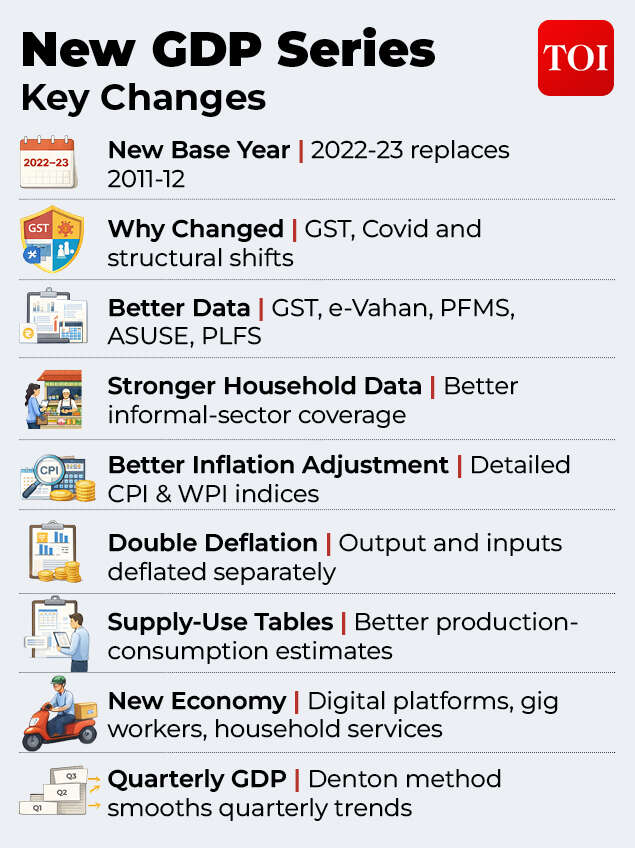
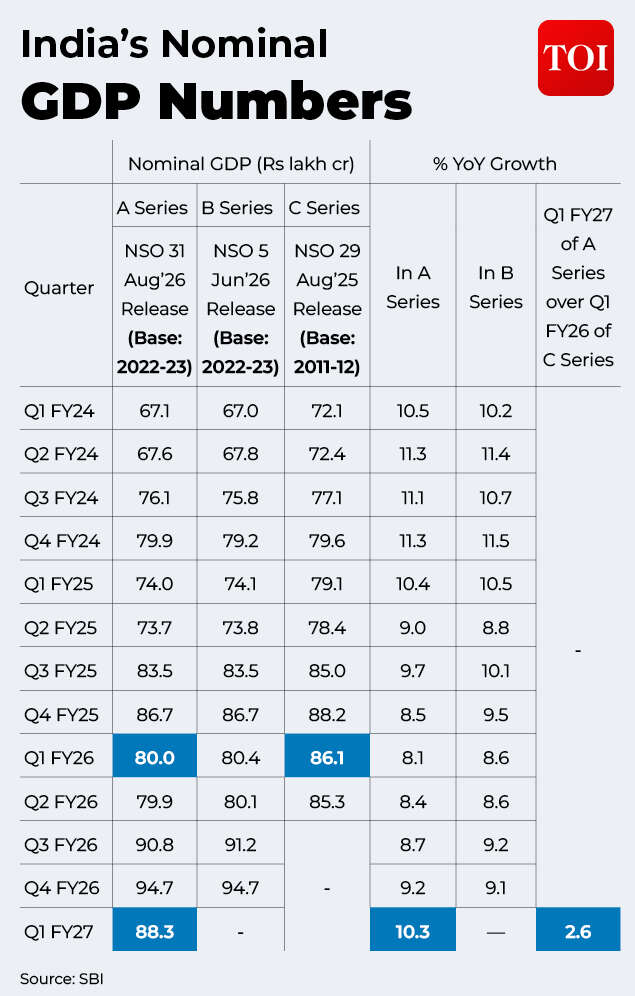
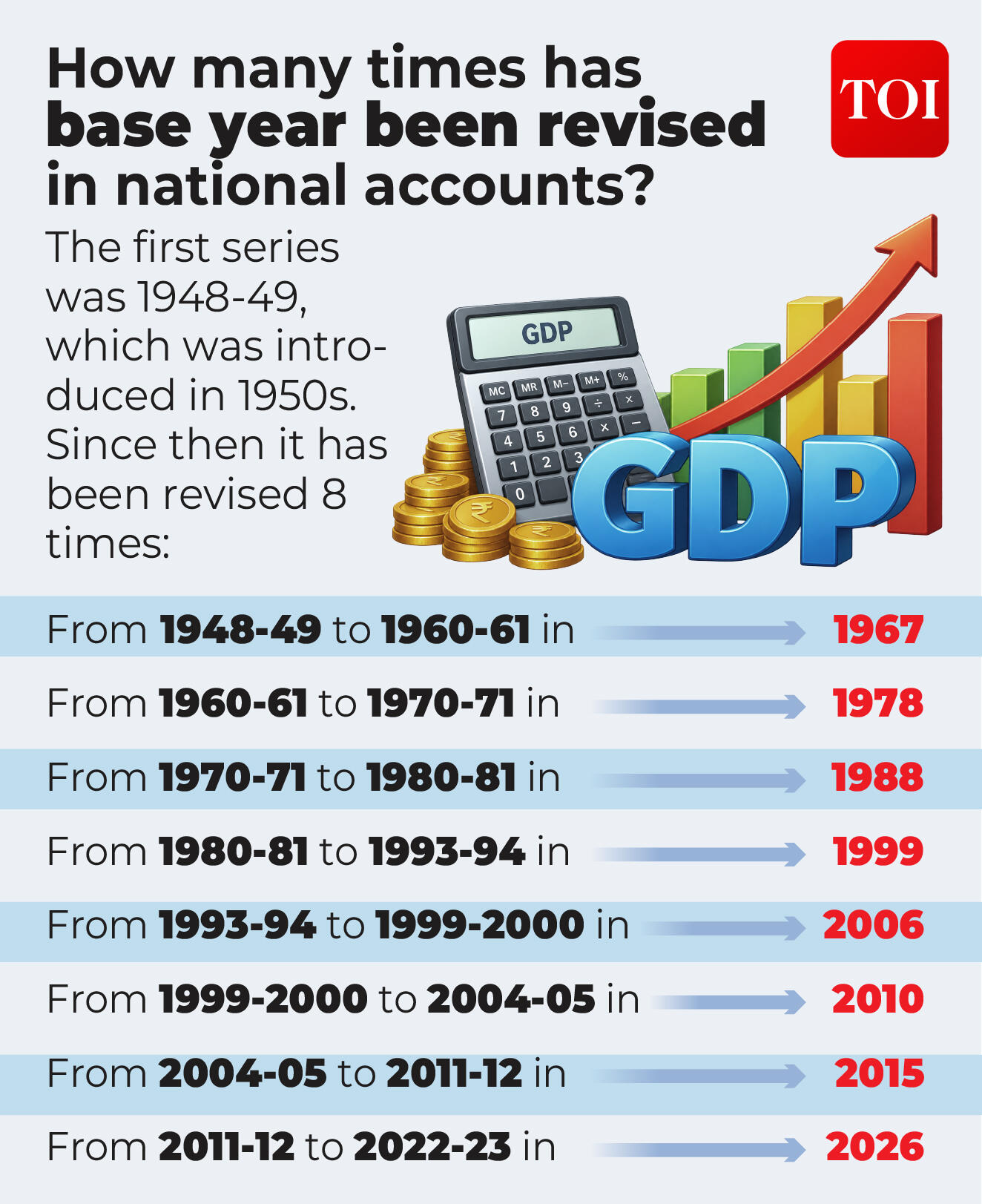
One of the biggest points of discussion and questioning is the revision to Q1 FY26 GDP at current prices, that is the figures for last year’s same quarter numbers.Let’s understand the chronology: Under the old 2011-12 series, GDP was estimated at Rs 86.05 lakh crore. However, under the new series with a base year of 2022-23 which was launched at the end of February, it was initially estimated at Rs 80.32 lakh crore, then revised to Rs 80.44 lakh crore and subsequently to Rs 80 lakh crore as more data and updated indicators became available.The base year for GDP calculations, and for that matter all major economic indicators such as IIP, CPI, WPI are periodically updated to give a better picture of the current economic situation. In that sense, the update of the base year was part of a routine exercise.
New GDP Series: Key changes
The government has rejected the allegations that last year’s GDP was reduced under the new series to make the current year’s growth rate appear stronger. It says the revisions to data is due to a combination of factors such as the change in base year, improved methodologies, updated data sources and incorporation of newer indicators.More importantly, the government says the old Rs 86.05 lakh crore figure cannot be directly compared with the latest Q1 FY27 estimate because they belong to different GDP series. For Q1 FY27 GDP of Rs 88.27 lakh crore, the appropriate comparison is the corresponding Q1 FY26 estimate under the latest 2022-23 series.In fact, the new methodology of GDP and GVA computation is said to be more aligned to international practices. The argument that economists are making is that the data cannot compare the old methodology based computation with the new methodology as there are several improvements made as per the new methodology aligning with global good practice.Soumya Kanti Ghosh, Member 16th Finance Commission & Group Chief Economic Adviser at SBI doesn’t mince words in a sharp note explaining the GDP numbers:Some estimates are now ascribing a 2.6% growth in nominal GDP for the latest quarter instead of 10.3%, by calculating yearly growth rate using Rs 88.3 lakh crore (which is A series in the table) over Rs 86.1 lakh crore (which is C Series).
SBI example of various series and India’s GDP data
“This is completely unsolicited and a sure sign of intellectual dishonesty. If anyone truly wants to compare current nominal GDP numbers over the previous unrevised base of Q1 GDP, then Rs 88.3 lakh crore (new base, A series) should be estimated over Rs 80.4 lakh crore (new base, B series), which comes out to 9.7% growth (as against 10.3%),” he says.In fact, hypothetically, he says that even with this nominal growth (by adjusting deflator), the real growth for Q1 FY27 would be 7.4%.
Why is the GDP deflator only 2.5%?
Another puzzle is the 2.5% implied GDP inflation rate. This is even as CPI inflation is around 3.9% and WPI inflation is much higher.The government has said that these indicators cannot be compared directly. While CPI measures household consumption, WPI captures wholesale goods and excludes services.The GDP deflator reflects the entire economy, which includes government spending, investment, exports and services.The latest GDP calculations use more than 300 individual price deflators, so the overall GDP deflator reflects price movements across a much broader set of economic activities.“The GDP deflator will never be equal to WPI or CPI. Historically under any series, the deflator is very different and does not follow any particular trend. It is derived by dividing nominal by real GDP and hence is derived. All the CPI and WPI numbers are not used for deflating components of GDP,” explains Madan Sabnavis, Chief Economist, Bank of Baroda.
Why is manufacturing showing negative inflation?
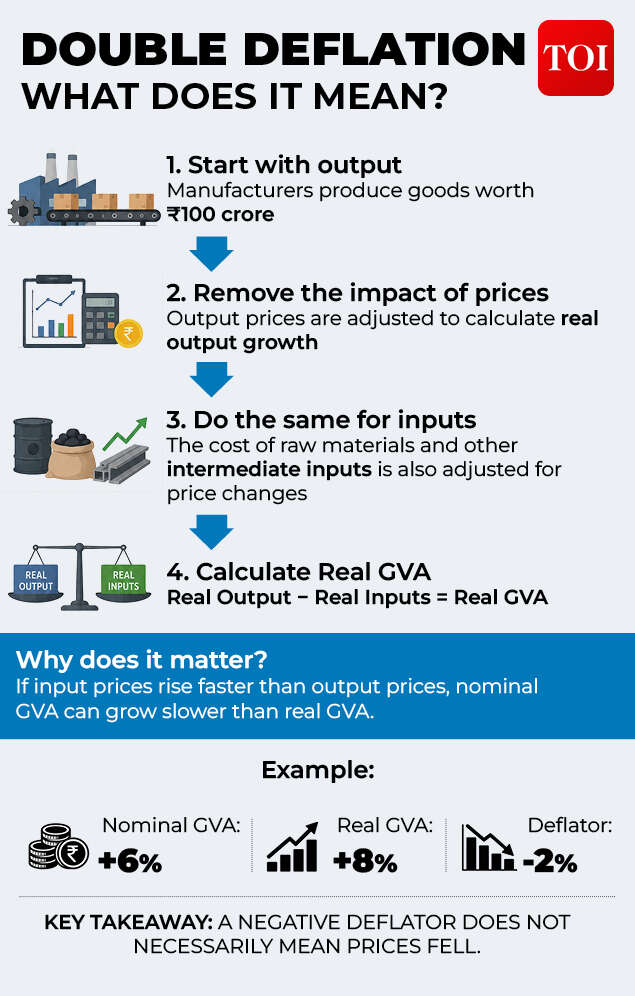
Another argument that is being used to question the accuracy of the GDP data is the deflator for manufacturing. Prices haven’t fallen, so why is inflation via deflator negative?In the case of manufacturing, the real GVA grew 9.2% but nominal GVA grew only 7.7%, which means an implicit GVA deflator of -1.5%.The government says this does not mean manufacturing prices fell.How this works is due to double deflation in which output and intermediate consumption are separately adjusted for price changes. If the prices of inputs rise faster than the prices of manufactured output, nominal GVA can grow more slowly than real GVA. This can result in a negative implicit GVA deflator even when both output and input prices are increasing.
How many times has base year been revised?
Madan Sabnavis gives the current context of the US-Iran war.“Companies have not quite passed on higher input costs which probably partly explains this phenomenon. This was a tough period where prices of several commodities went up especially those related to energy,” he tells TOI.Ranen Banerjee of PwC adds that manufacturing can have a negative inflator when the inputs are deflated at a higher rate than the rate at which the output is deflated.“We all are aware that there was a spike in input prices owing to the Middle East conflict. We are also aware that companies have been reluctant to pass on the entire cost increases to consumers and there has been only a partial pass on and that too mostly after the first quarter. Hence, a negative deflation for manufacturing is not surprising,” he says.
Double Deflation: What does it mean?
Mining illustrates the opposite effect. Real mining GVA contracted 2.4% in Q1 FY27, which broadly consistent with weak mining IIP data. But prices rose sharply. The prices of crude petroleum and natural gas, for instance, increased by 69.5% in April, 72.2% in May and 33.7% in June.As a result, nominal mining GVA grew 22.3%, even though real GVA contracted.
The bottom line
Economists note that the revision of quarterly GDP data is a periodic exercise.“Every year, MOSPI revises its previous year’s GDP estimates, both nominal and real, on a quarter-wise basis, reconciling them against the corresponding Annual Revised Estimates. These revisions are released in February each year. In the current year (this time on 31 Aug’26), the National Accounts Statistics (NAS) has additionally incorporated revised numbers of previous years in the quarterly data itself for sake of more transparency (Annual as well as Quarters) to align with the base revisions carried out in CPI, IIP, WPI and PPI. This is perfectly legitimate,” explains SBI’s Ghosh.This base alignment ensures that the GDP deflators and volume estimates remain consistent with the updated price and production indices underlying them.The bottom line: Revisions are part and parcel of a GDP number.Incidentally, India fell to the sixth spot in the world’s largest economy list partly due to the downward revision of the GDP numbers earlier this year.As Ghosh points out: The latest Q1 FY27 number will get finalised by February 2029 only!“This means we have to wait for 30 months to finally know where Q1 FY27 GDP numbers stand. Base revisions add an extra layer to this complicated process. Interestingly, base year revision by NSO this time has reduced the size of nominal GDP. Thus the argument of GDP getting bigger because of base year revisions is another meaningless argument that is unnecessarily doing the rounds,” he concludes.India has retained its tag of being the world’s fastest growing economy. As statistical methods evolve, calculations and final GDP numbers will continue to change. For now, one should take heart from the fact that high frequency indicators such as UPI transactions, GST collections, car sales – are all pointing to a resilient economy that is fighting global economic odds to keep its growth engine chugging.