

In 2001, scientists began adding 5 to 6 nanograms per litre of synthetic estrogen to an Ontario lake; after 2 seasons its minnow population collapsed

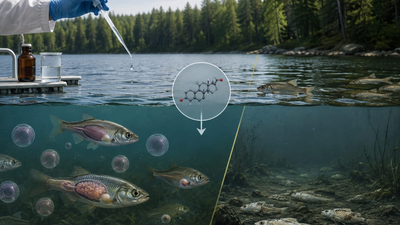
A tiny concentration of a synthetic hormone was enough to trigger a dramatic ecological change in a remote Ontario lake. In 2001, scientists began adding the synthetic estrogen 17α-ethynylestradiol (EE2) to Lake 260 in northwestern Ontario, maintaining concentrations of about 5 to 6 nanograms per litre. The experiment continued for seven years, including three years of estrogen additions and two years of observations after they stopped. The results, published in the Proceedings of the National Academy of Sciences (PNAS) in 2007, showed that chronic exposure disrupted reproduction in fathead minnows and eventually brought the species near extinction in the lake. The study, Collapse of a fish population after exposure to a synthetic estrogen, was led by Karen A. Kidd and colleagues.
A controlled lake experiment
The experiment was conducted at the Experimental Lakes Area (ELA), a network of freshwater lakes used for ecological research. Lake 260 covered about 34 hectares and had a maximum depth of 14 metres. It contained naturally reproducing populations of several fish species, including fathead minnows, lake trout, white suckers and pearl dace.Researchers also monitored nearby reference lakes, including Lake 442, which had similar physical and biological characteristics but did not receive the synthetic estrogen. This comparison allowed scientists to distinguish changes associated with EE2 exposure from the natural fluctuations that can occur in fish populations. Beginning in May 2001, researchers added EE2 three times a week during the open-water season. The target concentration was between 5 and 6 ng/L, with measured seasonal averages of 6.1 ng/L in 2001, 5.0 ng/L in 2002 and 4.8 ng/L in 2003.
Changes appeared quickly
The effects were visible well before the fish population collapsed. Just seven weeks after the first additions, male and female fathead minnows showed elevated levels of vitellogenin, a protein normally associated with egg production in females. In males, whole-body vitellogenin concentrations were roughly three orders of magnitude higher than those measured in reference fish.The hormone also interfered with the development of the fish’s reproductive organs. During the first spring after exposure began, male fathead minnows showed delayed sperm development, abnormal testicular tissue and other reproductive changes. By spring 2003, some males had developed ova-testes, meaning ovarian tissue was present within their testes. Such intersex development can reduce reproductive success because affected males may produce less sperm or sperm with reduced mobility.
The population collapsed
The most striking consequence emerged at the population level. Fathead minnows have a relatively short life cycle. Most become sexually mature during their second year, meaning repeated reproductive failure can rapidly affect the number of fish in a population. That is what happened in Lake 260. Researchers recorded a consistent decline in fathead minnow abundance after EE2 additions began. The population collapsed in fall 2002, after the second season of estrogen additions, largely because young-of-the-year fish had disappeared.The contrast with the reference lake was important. The same loss of younger fish was not observed in Lake 442, which had not received EE2. The decline continued even after the additions eventually stopped. Reproductive failure persisted for two additional years, although a small number of young fish were still detected each year. By the fifth year after EE2 additions began, fathead minnow catch-per-unit-effort in Lake 260 had fallen to 0.1, compared with 180 before the additions.
A warning about low concentrations
The experiment demonstrated why measuring only the concentration of a contaminant may not tell the whole ecological story. EE2 was present at concentrations measured in parts per trillion, yet prolonged exposure produced effects that moved from molecular and reproductive changes to an almost complete loss of a fish population. The researchers concluded that continued exposure to natural and synthetic estrogens entering aquatic environments through municipal wastewater could reduce reproductive success and threaten fish populations. They also noted that short-lived species such as fathead minnows may be particularly vulnerable because population numbers can respond rapidly when several breeding cycles are disrupted. The Lake 260 experiment therefore provided rare whole-ecosystem evidence that an estrogenic contaminant, even at very low concentrations, can move through multiple levels of biological impact, from altered hormone-related proteins and reproductive organs to the collapse of an entire fish population.