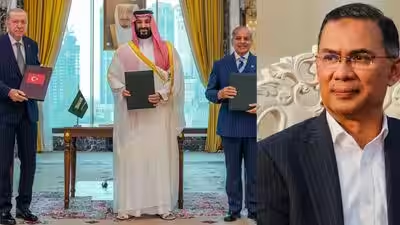

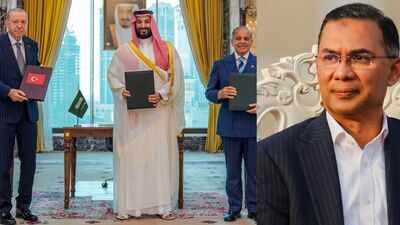
In August, Saudi Arabia, Pakistan, and Türkiye unveiled what has informally been dubbed the “Islamic Nato”. Named after Makkah, Islam’s holiest city, the Makkah Joint Defence Agreement or simply the Mecca pact—is based on the principle that an armed attack on one member would be considered an attack on all three, similar to Nato’s Article 5.Since the pact was announced, Bangladesh has signalled that it could join the grouping. Bangladesh Prime Minister Tarique Rahman has not publicly commented on the possibility, but his foreign minister and junior ministers have said Dhaka is “interested” and would respond “positively” if invited.Against that backdrop, Saudi Crown Prince and Prime Minister Mohammed bin Salman’s invitation to Tarique Rahman to visit the Kingdom is also likely to attract added attention.What lies behind Dhaka’s interest in the pact is less clear. But several factors could be shaping its thinking.
Mecca pact : A different security calculus for Dhaka
Over the years, Bangladesh, as a member of the Non-Aligned Movement, has followed a policy of not taking sides with major powers during conflicts. Experts also point out that, unlike the three founding members of the Mecca security alliance, Bangladesh does not face the kind of immediate external military threat confronting some of the pact’s founding members.Others have raised concerns about the agreement’s “collective security” principle, arguing that it could draw Dhaka into a war not of its own making.
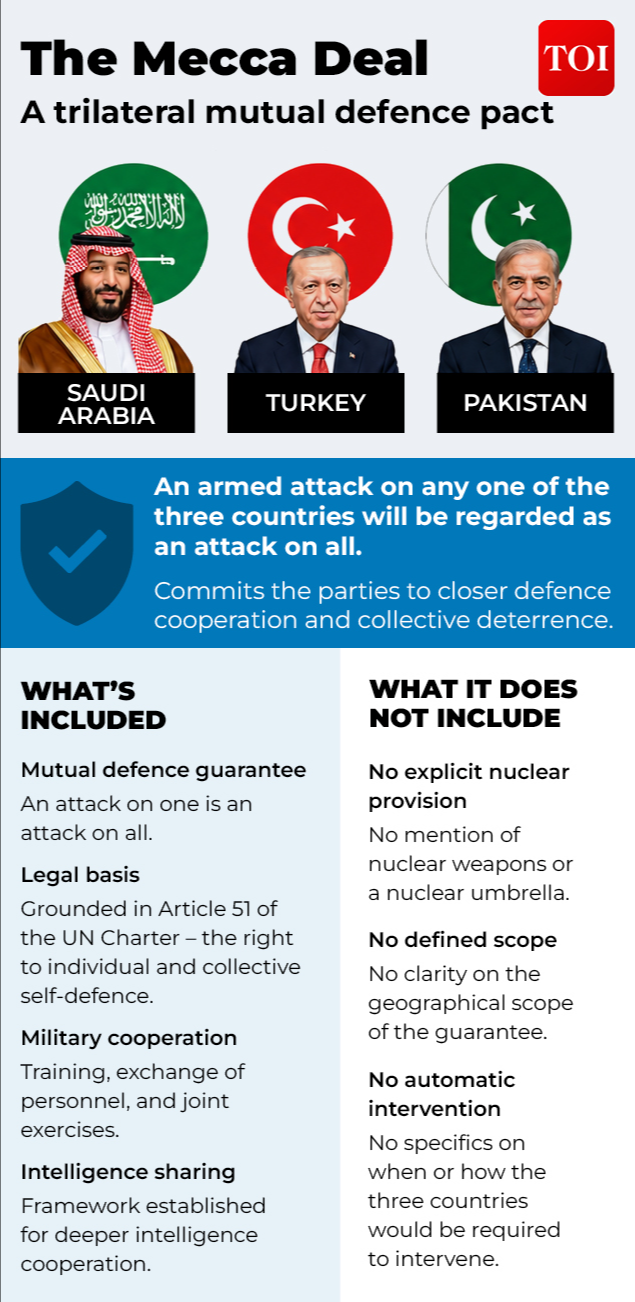
What is Mecca Joint Defence Agreement
Why, then, are Bangladesh’s ministers talking about joining the tri-nation agreement?According to Professor Sreeradha Datta, who teaches International Affairs at OP Jindal Global University, Bangladesh would definitely want to leverage the interest of other countries in it.“I think right now, Bangladesh would like to have a reach beyond the (immediate) region. And if others are getting interested in Bangladesh, why wouldn’t they leverage it?” Professor Datta told The Times of India.Besides, the three countries would offer Bangladesh different advantages. Pakistan brings military and strategic weight in South Asia and is the only Muslim-majority country with nuclear weapons; Türkiye offers high-tech defence capabilities and technology, as well as Nato’s second-largest military; and Saudi Arabia brings economic and diplomatic weight.
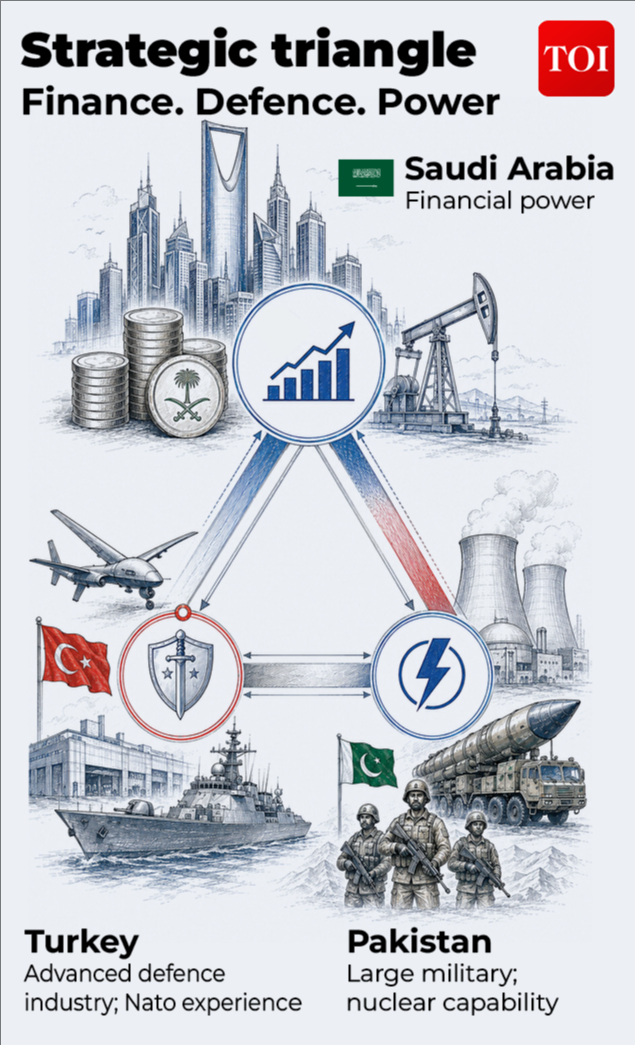
What Saudi Arabia, Pakistan and Turkiye bring to the table
Taken together, these ties could give Dhaka access to a wider range of strategic, military and economic partnerships, while allowing it to expand its reach beyond the immediate region. In return, Bangladesh would bring a sizable military to the alliance and give the grouping a member strategically located on the Bay of Bengal.
The ‘Muslim family’ argument
On August 30, a day before the alliance’s first meeting in Türkiye’s Istanbul, Bangladesh’s foreign affairs minister Khalilur Rahman reiterated a point he had made previously: that joining the Mecca pact was a matter for the world’s “Muslim family.”
Bangladesh would positively consider joining the Mecca defence, if invited… It is an internal matter of “our Muslim family” with no scope for others to be concerned about it
Khaliliur Rahman, Bangladesh foreign minister
The minister’s framing of the agreement, therefore, allows Dhaka to present its interest partly through the lens of shared religious identity, even though formal membership would carry significant strategic obligations.Professor Datta, however, also pointed to Bangladesh’s longstanding interests with these nations.“They (Bangladesh) have a lot of interests like energy and remittance and many other interests with these countries. In any case, it has a very growing relationship with Turkiye and has always had very good engagements with them,” she said.Meanwhile, Pakistan claimed after the bloc’s Istanbul meeting that several other Muslim-majority states had expressed interest in joining the pact, suggesting that the grouping could expand while remaining exclusively Muslim-majority.
A calculation for domestic politics?
Bangladesh ministers have repeatedly asserted that the Tarique Rahman government’s approach to the Saudi Arabia-Pakistan-Türkiye military alliance is guided by its “Bangladesh First” policy, with “national interests at its core.”Foreign minister Khalilur Rahman, for instance, stated that Bangladesh will “never bow its head to anyone again” and that the current government has “buried the subservient foreign policy.”Professor Datta said there is also a domestic political dimension, with the incumbent government potentially seeking to appeal to a constituency that remains deeply invested in the “Hasina factor.”“Given the tense relationship with India, the domestic constituency is of course very important and there is a large constituency that obviously considers the Hasina factor very strongly,” she said, referring to former Prime Minister Sheikh Hasina, who was ousted in a student-led movement in 2024 and has been living in New Delhi since then.Against continuing political hostility towards Hasina, Dhaka’s signalling on the pact could also carry a domestic political dividend, particularly among constituencies supportive of a more independent foreign-policy posture.Therefore, the government’s signalling on the Mecca pact can be politically useful, whether Bangladesh ultimately joins the alliance or not.
The India factor in Bangladesh’s calculus
As an immediate neighbour, India cannot afford to ignore Bangladesh’s strategic choices. The two countries share a more than 4,000-km-long border spanning five Indian states, making Dhaka central to New Delhi’s security and strategic calculus.But diplomatic tensions, with the non-extradition of Sheikh Hasina at the centre of the dispute, continue to strain bilateral ties. The former prime minister was convicted in absentia and sentenced to death for crimes against humanity linked to deaths during her administration’s crackdown on protests, although she has rejected the conviction as a “political witch hunt.”For his part, Tarique Rahman, since becoming prime minister in February, has visited several Asian countries, including China, but is yet to visit India. That he is yet to visit India despite invitations from New Delhi reflects the continuing sensitivity in bilateral ties.However, New Delhi has repeatedly signalled its interest in hosting him. Could Bangladesh’s signalling on the Mecca Pact, therefore, be a message to India that Dhaka is keeping its options open?Professor Datta sees Dhaka’s approach as a way of telling major powers, including India, that Bangladesh has other options, so that it need not depend on any one external power.“They’re telling everybody, including India, that we have other options… It’s more of a both domestic and external messaging that ‘We (Bangladesh) have other options so that we don’t have to depend on one particular external power’,” she said.Additionally, Bangladesh knows that if it joins the alliance, two of its three partners would be countries whose ties with India have faced significant strains — Pakistan and Türkiye.In fact, Bangladesh-Pakistan ties had already improved significantly under the Muhammad Yunus-led interim administration in Dhaka, well before the Mecca pact emerged. The rapprochement included reciprocal security visits, raising eyebrows in New Delhi.For Bangladesh, therefore, simply signalling interest in the agreement could send a message to India that it is considering other strategic options while the relationship remains strained.
What would Bangladesh’s Mecca Pact membership mean
For Dhaka, a formal membership would mean taking on the commitments that come with a collective-defence arrangement. That would mark a significant shift for a country that has traditionally been reluctant to enter formal military alliances.But Professor Datta does not expect Bangladesh to become a direct member of the alliance, at least for now. Some form of association, she believes, could be more plausible.“I don’t think, at this point, Bangladesh is going to join the alliance as a direct member. In some form of association, maybe an observer status, but they will certainly have other considerations.”One of those “considerations,” she says, is likely to be domestic opinion towards Pakistan. While official engagement between Dhaka and Islamabad has grown, a formal defence alliance could be politically difficult to sell at home as it may not go down well with the public, given the history between the two nations.For now, therefore, it remains to be seen whether Dhaka will restrict itself to signalling interest or go beyond it and pursue some form of formal association with the alliance.