
Glacier collapse at 8.37am, alert at 9.15: Why Nepal sent disaster warning 38 minutes late

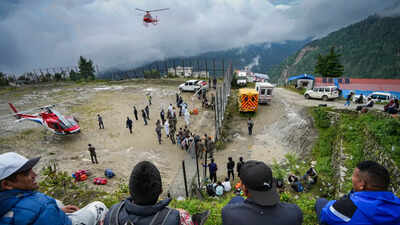
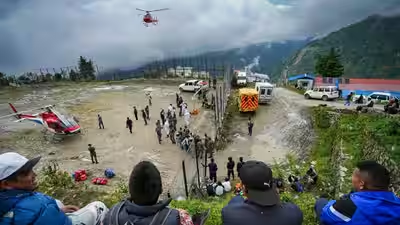
Nepal’s warning system came under scrutiny after a glacier collapse triggered devastating flash floods in Rasuwa on August 26, with authorities issuing a disaster alert 38 minutes after the ice-rock avalanche. The deadly floods have killed thousands and several remain missing.The collapse struck the Lhende valley near the Nepal-Tibet border at 8.37am, sending a rapid surge of water, debris and boulders downstream. Communities were caught off guard, with survivors relying largely on instinct and help from neighbours to escape, according to a report in the Kathmandu Post.Scientists said predicting the specific glacier collapse was difficult and the steep terrain gave authorities little time to respond. However, the disaster exposed a wider weakness: Nepal’s warning systems are largely built around individual hazards even as Himalayan disasters increasingly involve cascading and cross-border risks.“There is no such thing as an early warning system in Nepal. Simply having sensors does not mean it’s a system; it has to be much more comprehensive,” the report quoted Anil Pokhrel, former chief executive of the National Disaster Risk Reduction and Management Authority saying.He said an effective system needs risk assessment, real-time observation, communication mechanisms and emergency preparedness. “If the Chinese sensors detect something upstream, a series of sirens should automatically go off all at once. Text messages should go off with a loud buzzer even if it is on silent mode,” he added.
Why alert was sent late
Nepal’s department of mines and geology recorded seismic activity when the glacier collapsed, but did not issue an alert because the signal did not match the pattern of an earthquake.“Our records showed a 4.4 magnitude. But the frequency of the seismic activity did not match that of an earthquake, which is the department’s monitoring mandate, so we did not alert the public like we usually do,” the Post quoted Lok Vijay Adhikari, chief of the National Earthquake Monitoring and Research Center saying.A second opportunity to detect the danger came when water levels began rising in the Bhotekoshi. But at 8.50am, the flash flood swept away the river gauge at the Syabrubesi hydrological station. The gauge was designed to monitor gradual rises in river levels and was not equipped to detect such a fast-moving flood.At 9am, Rasuwa’s district administration informed the department of hydrology and meteorology (DHM). Communications towers had already been destroyed, forcing local officials and residents to rely on door-to-door warnings.“We informed DHM at nine. We could not do much in Rasuwa because the flood had destroyed the [communications] towers, yet local authorities informed communities, and people went from door to door warning each other,” the report quoted Shanti Mahat, spokesperson of NDRRMA, saying.“But for people downstream we used every means to inform them—through text alerts, caller tune, media broadcasts, and police miking,” she added.At 9.15 am, 38 minutes after the avalanche, alerts reached people in Rasuwa, Nuwakot, Dhading and Chitwan, urging them to move to higher ground. Tamang’s phone, however, showed that he received the warning at 9:42 am.
Blind spot beyond Nepal’s borders
The Rasuwa disaster also highlighted gaps in cross-border monitoring. The Lhende Khola originates in Tibet and flows towards Nepal, feeding into the Bhotekoshi and Trishuli rivers.Nepal has flood forecasting and data-sharing arrangements with India, but there is no comparable operational early-warning protocol with China despite a 2019 commitment by the two countries to cooperate on climate change and environmental issues.“There is no protocol. The practice that we have right now is that we cooperate with the ministry of foreign affairs to share information,” said Prakash Pokhrel, geologist at NDRRMA.“Whenever a foreign country is involved, we have to go through the ministry.”Monitoring the remote northern reaches also remains difficult. Officials said the terrain is extremely challenging and real-time monitoring stations are difficult to establish.DHM information officer Dinkar Kayastha said it was impossible to monitor every vulnerable area with available resources, particularly given Nepal’s mountainous terrain.Nepal monitors major high-risk glacial lakes, while ICIMOD has identified 21 potentially dangerous glacier lakes among 2,070 lakes across the Gandaki, Koshi and Karnali basins.ICIMOD warned in March that glaciers in the Hindu Kush Himalaya were losing ice at twice the rate recorded since 2000. Yet many glaciers remain largely unmonitored.The disaster also exposed the vulnerability created by development in the Himalayan river valleys. Thirteen hydropower plants in Rasuwa and Nuwakot were damaged, disconnecting around 431 MW of capacity from Nepal’s national grid.