
Researchers tested gravity across galaxy clusters separated by hundreds of millions of light-years and found it behaves almost exactly as Newton and Einstein predicted, strengthening the case for dark matter

Gravity is best known as the force that keeps us on Earth, but its effects extend throughout the cosmos. It influences the motions of stars, galaxies and clusters of galaxies, and helps determine the development and growth of the biggest structures in the universe. Yet astronomers have faced a puzzling problem for a long time. Stars and galaxies can sometimes seem to move far faster than their visible matter should allow. That discrepancy has spawned two competing ideas. Either the universe is filled with vast quantities of unseen dark matter, or the laws of gravity change on huge cosmic scales. Now one of the biggest tests ever has been carried out by University of Pennsylvania researcher Patricio A. Gallardo and his collaborators. Published by Science Daily, the research talks about Newton’s 300-year-old law and more. For this, researchers used data from the Atacama Cosmology Telescope (ACT) to study how gravity behaves between clusters of galaxies separated by hundreds of millions of light years. Their results, published in Physical Review Letters, show that gravity weakens with distance almost exactly as predicted by Newton’s inverse-square law and Einstein’s theory of general relativity. “The law of the inverse of the squares continues to be consistent with observations on scales that would have been unthinkable when Newton built his theory in the 17th century,” says Gallardo. The result is a powerful confirmation of a fundamental tenet of modern physics, and it places important constraints on theories that would modify gravity itself.
The mystery of the rapidly recurring galaxies
As per the research, some of the argument comes from the way we observe the motions of galaxies. In a simple Newtonian model , stars farther from the center of a galaxy should orbit more slowly , since they are under the influence of less gravity from the visible mass. Instead, astronomers have discovered that stars in the outer portions of galaxies tend to move much faster than expected. Similarly, inside galaxy clusters, entire galaxies are seen moving at speeds not consistent with the amount of visible matter. This leaves scientists with a big cosmic accounting problem. Either gravity works in a different way at the largest scales or there must be some more matter whose gravitational effects can be detected, although the matter itself cannot be seen directly. One proposed alternative is Modified Newtonian Dynamics or MOND which changes the behavior of gravity at very low accelerations.
New clue from ancient light
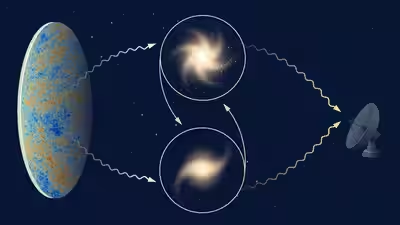
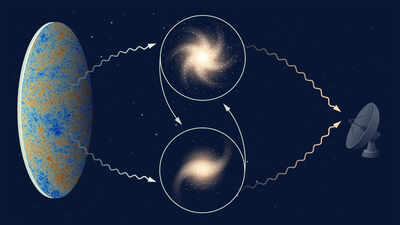
To try to distinguish between these possibilities, Gallardo’s team used the cosmic microwave background, or CMB, faint radiation left over from the early universe. The CMB was released about 380,000 years after the big bang and has been streaming out across the universe ever since. Its light passes through massive structures on its way, including galaxy clusters. Their motion imprints tiny signatures in the CMB, which astronomers can measure. The researchers studied these effects across hundreds of thousands of galaxy clusters and huge stretches of space with observations from ACT. This enabled them to test the variation of gravitational strength over some of the largest structures in the universe. Had modified-gravity theories such as MOND been correct, the observations might have shown a different pattern, with gravity fading out more slowly than predicted by standard theories. Instead, the measurements were consistent with the behavior predicted by Newtonian gravity and general relativity .
Dark Matter back in the spotlight
The results indicate that modifications of the laws of gravity are not a plausible explanation for the missing gravitational effect observed in galaxies and clusters. That bolsters the case that dark matter is an as-yet-unknown component of the universe we can only tell is there because of its gravitational influence. But it can’t tell us what dark matter actually is. Scientists don’t know whether it’s a new type of particle or another form of matter.
The search goes on
Future observations could allow even more precise tests. Researchers expect that improved measurements of the CMB, coupled with ever more extensive galaxy surveys, will open new avenues for testing gravity on cosmic scales. The latest results suggest that, for now at least, Einstein’s and Newton’s theories of gravity remain remarkably resilient, even on scales neither scientist could have imagined. So the deeper mystery may not be that gravity is acting strangely, but that so much of the stuff that makes up the universe is invisible.Image Courtesy: Lucy Reading / Simons Foundation