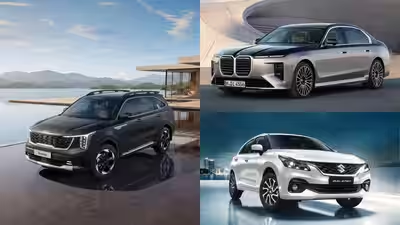

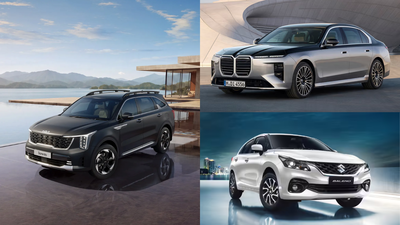
September is set to bring more new car launches and updates to the Indian market, following a busy August that saw several new models, variants and updates. Last month, the BMW X1 LWB and MG Hector Tomahawk EV and PHEV launched, while the Mahindra Scorpio N received a mid-lifecycle update. The Mahindra BE 6 also gained the ‘Sporteq’ suffix, and three existing models – the Range Rover SV Ultra, BYD Sealion 7 Dynamic and Skoda Kylaq Sportline received new trims. With more launches lined up for September, buyers can expect new options across multiple segments. Here’s a look at the cars expected to arrive in India this month.Kia SorentoKia will add the Sorento as its new flagship ICE model in India on September 4. It will be offered with a 1.6-litre strong-hybrid producing 238hp and 380Nm, as well as a 2-litre diesel developing 202hp and 441Nm. The Sorento’s front end features Kia’s Tiger Nose grille, vertical LED headlights with Y-shaped DRLs, LED fog lamps and aero vents at the bumper’s outer edges. Kia has not confirmed the wheel size, but 19-inch alloys are expected. The rear gets squared tail-lights with an inverted L-shaped LED pattern, a large roof spoiler and a two-tone bumper.Inside, the dashboard uses a connected screen layout for the infotainment and instrument cluster. Both displays are expected to measure 12.3 inches, although their sizes have not been confirmed. Kia’s official images also show ADAS, ventilated front seats, a digital IRVM, a powered tailgate, dual-zone climate control, ambient lighting and a panoramic sunroof. The Sorento is expected in six- and seven-seat versions. Bookings are already open, with the SUV set to rival the Skoda Kodiaq, Volkswagen Tayron and Jeep Meridian.Maruti Baleno faceliftMaruti Suzuki is preparing to update the second-generation Baleno, which was introduced in 2022. Spy images point to a redesigned front with a new grille featuring a horizontal bar connecting the headlights. The bumper also appears to lose the fog lamps offered on the current car.At the side, the main change is expected to be a new alloy wheel design. A revised rear bumper could be added, while the tail-lights are likely to remain unchanged. The cabin is expected to retain the 9-inch touchscreen, with revised upholstery and additional features.The existing engines are likely to continue. The petrol version uses a 90hp 1.2-litre naturally aspirated engine with five-speed manual and five-speed AMT options. The 77.5hp CNG version will remain available exclusively with the manual gearbox. Rivals will continue to include the Tata Altroz, Hyundai i20 and Toyota Glanza.BMW 7 Series and i7 faceliftsBMW will launch the updated 7 Series and i7 in India on September 11. Bookings opened on August 1 following their global debut earlier this year. The Indian 7 Series range currently consists of the 740i petrol and 740d diesel, while the i7 is sold in eDrive 50 and M70 xDrive forms. BMW has not yet confirmed which variants of the updated cars it will offer here.The facelifted 740i and 740d retain their 3.0-litre straight-six engines but gain more power. The 740i now produces 400hp and 580Nm, up 19hp and 60Nm, while the 740d makes 313hp and 670Nm, an increase of 27hp and 20Nm. Both continue with 48V mild-hybrid systems, eight-speed automatic gearboxes and xDrive all-wheel drive.The i7 receives a 112.4kWh battery, replacing the previous 101.7kWh unit. The 50 variant now comes only with xDrive and makes 455hp and 660Nm, up 6hp and 10Nm. The M70 xDrive produces 680hp and 1,100Nm, gaining 30hp and 85Nm. Charging speeds have also been increased.Both models get revised styling, including split LED headlights, slimmer and taller kidney grilles with illuminated surrounds and larger bumper air intakes. Changes along the side include redesigned side skirts and alloy wheels, while the rear receives wraparound LED tail-lights, a new tailgate and revised bumper.The cabin has also been updated, with a 17.9-inch infotainment screen, 14.6-inch passenger display and BMW’s full-width Panoramic Vision display at the base of the windscreen. A four-spoke steering wheel replaces the previous design, while the centre console and transmission tunnel have been revised.Rear passengers get powered seats with heating, ventilation, massage and lumbar support. The 31.3-inch 8K Theatre Screen can now be controlled by touch, and the rear-door displays have also been updated. Other features include ambient lighting, a Bowers & Wilkins surround sound system and four-zone climate control. The 7 Series will continue to compete with the Mercedes-Benz S-Class, which was also facelifted this year.Porsche Cayenne ElectricPorsche will showcase the Cayenne Electric in India on September 30, after announcing its prices in November last year. The standard version costs Rs 1.77 crore, while the Turbo Electric is priced at Rs 2.27 crore, both ex-showroom.Both variants use a 113kWh battery and dual-motor all-wheel drive. The Turbo Electric produces 1,156hp and 1,500Nm with Launch Control and reaches 100kph from a standstill in 2.5 seconds. Its top speed is electronically limited to 260kph, while the claimed WLTP range is 537km. The standard Cayenne Electric develops 442hp and 835Nm with Launch Control. It takes 4.8 seconds to reach 100kph and has a 230kph electronically limited top speed. Its claimed WLTP range is 542km.The EV retains the overall shape of the ICE-powered Cayenne but gets a closed-off grille and two bumper-mounted air vents for cooling the battery and electrical components. The Turbo has larger vents. At the rear, a full-width LED light bar incorporates illuminated Porsche lettering, while the bumper uses horizontal black elements.The interior shares its basic layout with the ICE model, including a three-spoke steering wheel and digital driver’s display. A new 14.5-inch curved infotainment screen extends into the centre console, while a 14.9-inch passenger display is available as an option. Equipment includes eight-way electrically adjustable front seats, four-zone automatic climate control, ventilated front seats, a panoramic sunroof and wireless phone charging.