
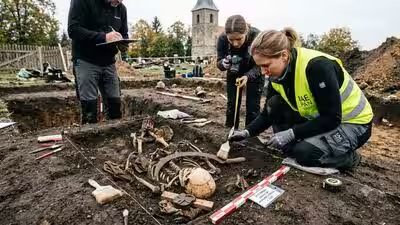
Archaeologists are investigating a 400-year-old Polish grave where a young woman was buried in a way meant to prevent her return | World News

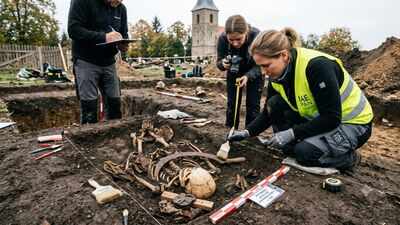
A young woman buried in a Polish cemetery more than four centuries ago was not left to rest in the ordinary way. Archaeologists studying Grave 75 have found evidence that her burial was deliberately altered after her death, with an iron sickle placed across her neck and a padlock fastened to her toe. The unusual arrangement appears to have been intended to keep her from leaving the grave or harming the living. Yet the woman’s story is more complicated than the objects suggest.According to Archaeology News Online Magazine, she was probably only 17 or 19 when she died, and traces of expensive silver and gold decoration indicate that she may have come from a relatively prosperous household. Her teeth, bones and DNA are now helping researchers piece together who she was and why someone later feared her return.
Young woman in Grave 75 was buried with costly silver and gold decoration
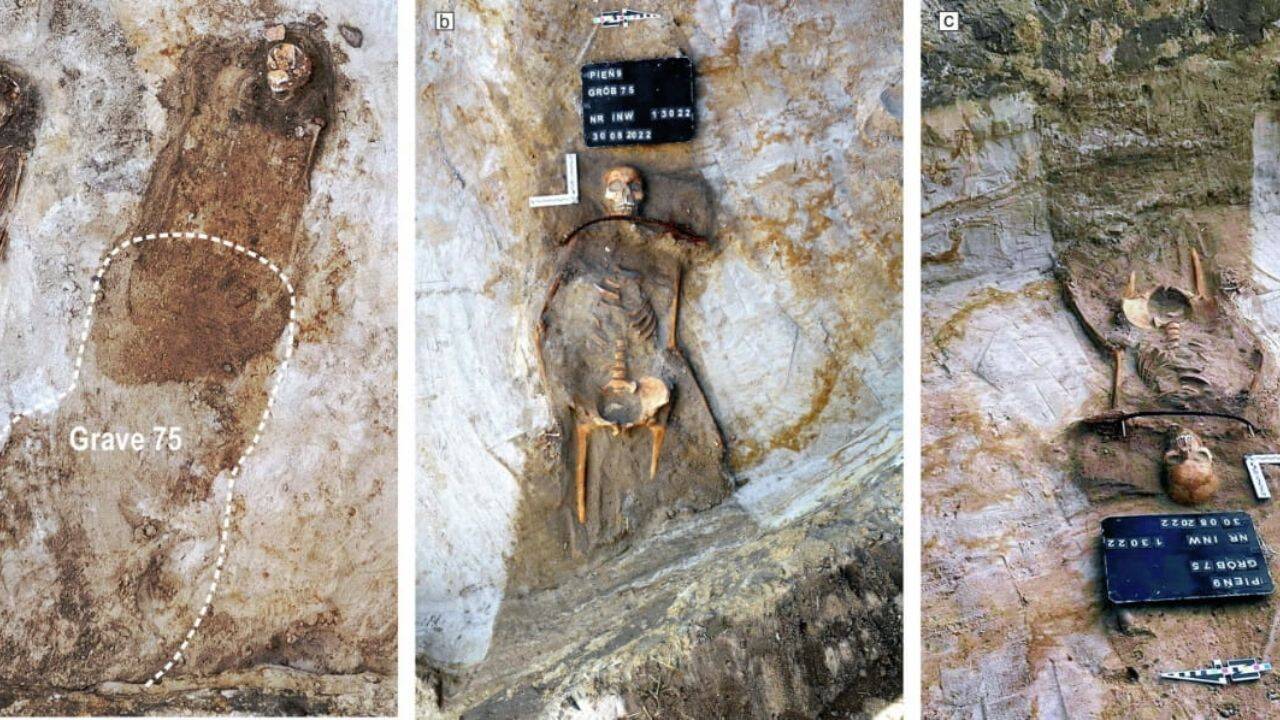
The burial, known as Grave 75, was uncovered during excavations in 2022. Radiocarbon analysis places the woman’s death somewhere between 1620 and 1674, when she was probably between 17 and 19 years old.There are signs that she came from a comparatively affluent household. Tiny pieces of material recovered around her head were part of an elaborate textile accessory, made using extremely fine silver and gold-gilded wire. Such decoration would have been expensive, particularly at a time when precious metals were not everyday materials. Her appearance in life can therefore be partly reconstructed from what survived around her. She was young, apparently well dressed and buried with items that suggest a degree of social standing.
Woman’s teeth and bones reveal clues about her early life
Reportedly, chemical analysis of her teeth and bones indicates that she consumed relatively little animal protein compared with many other adults buried at the same cemetery. That finding may point towards periods when food was scarce or access to certain foods was limited.It is an unusual combination. Material evidence suggests that the woman had access to expensive clothing or accessories, yet the chemistry of her remains does not suggest a consistently rich diet. Her childhood appears to have been spent locally. Isotope analysis of her teeth points towards the area around Pień, meaning that despite her unusual genetic ancestry, she was probably not someone who had recently arrived from a distant region. DNA provides another piece of the puzzle.
DNA testing revealed the woman’s rare maternal lineage
Genetic testing placed the woman’s maternal lineage in haplogroup J1c2c1. The lineage has Scandinavian roots and is now particularly uncommon among Slavic populations.That does not mean she was necessarily Scandinavian herself. Genetic lineages can persist across generations and move between populations, so a maternal connection to Scandinavia does not establish where the woman or her immediate family came from.The combination is nevertheless interesting: a woman apparently raised near Pień carried a maternal lineage that was unusual for the local population.Her biological history becomes harder to interpret when the evidence from the grave is considered. Something happened after she was initially buried.
The grave was reopened before the body had fully decomposed
The position of the bones suggests that the burial was disturbed before the body had completely decomposed. Parts of the skeleton had shifted, while traces of remaining soft tissue indicate that the body was still held together when the grave was reopened.This detail is important because it suggests the unusual arrangement was not part of the original funeral.The later visitors appear to have moved the body before placing the iron sickle across her neck. The blade was turned towards the throat, while the handle had already disappeared. Analysis of the surviving wood identified it as birch.A second object was added at the same time or during the same episode. A padlock was attached to the woman’s left big toe. Together, the two objects appear to have served as restraints.
The unusual burial reflects fears of a restless or dangerous dead
Sickles occur in a number of unusual burials from Central and Southeastern Europe. In some cases, they appear to have been placed so that a dead person could not rise from the grave.The arrangement at Pień fits that pattern. The sickle’s blade lay across the neck, creating a physical barrier that would have made movement difficult. The lock on the toe offered another symbolic or practical means of preventing the body from leaving its burial place.These actions were tied to beliefs about dangerous or restless dead. In communities where unexplained deaths, illness or repeated misfortune were difficult to understand, suspicion could fall on particular individuals even after they had died.Later descriptions of such practices often use the language of vampires, although people in the 17th century did not necessarily understand the dead in precisely the way the modern word suggests.
A burial shaped by fear of the dead
The period in which this woman lived was marked by disease, food shortages and social disruption across parts of the Polish-Lithuanian Commonwealth. Death could come suddenly, and the reasons behind it were not always clear.That uncertainty could influence how communities dealt with the bodies of people who were regarded with suspicion. A person thought capable of causing harm after death might be buried differently from others, sometimes with objects intended to prevent a return.The sickle and padlock appear to belong to this wider tradition of anti-demonic treatment.The choice of objects may also have carried meanings beyond their physical function. The birch handle, for example, has been linked by the researchers to historical protective associations in the region.Still, there is no evidence that the woman herself had been accused of anything during her lifetime. The archaeological record only shows what was done to her after burial.
The green stain remains unexplained
Another unusual clue was found around the woman’s mouth and neck. The bones and surrounding material carried a greenish stain.Chemical examination ruled out the possibility that it came from an old coin placed in the grave. Instead, the colouring appears to have resulted from contact with copper or a copper-rich substance.Exactly what produced the stain remains uncertain. It could have come from an object that has not survived, or from material that was placed near the body during one of the burial episodes. With much of the original grave context disturbed, there is no simple way to establish what happened.
The cemetery itself raises questions
The location of the burial ground adds another layer. Historical maps do not appear to record the cemetery, and archaeologists have not found the crosses or devotional objects that might normally be expected at a Catholic burial site.The cemetery was also situated away from the settlement, close to a crossroads. That location may be significant. Marginal burial places were sometimes used for people whose deaths or reputations made ordinary burial arrangements difficult. It is not possible to say with certainty that everyone buried at the site was feared or rejected, but its setting makes the question worth considering.Grave 75 stands out because the evidence is unusually clear. Someone came back after the young woman had been buried and changed the arrangement of her body.