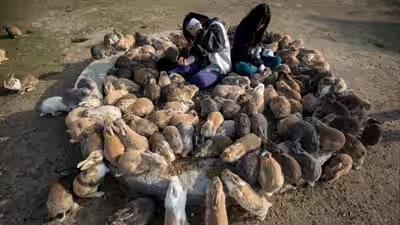
In 1903, rabbits were released on Hawaii’s Laysan Island as a food source; within a decade they had nearly stripped it bare, and three of its five landbird species eventually went extinct

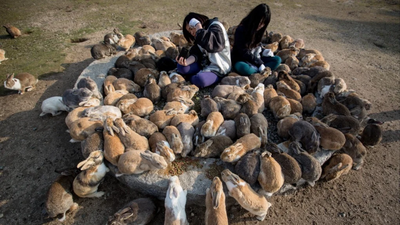
When German immigrant Max Schlemmer brought a small number of domestic rabbits to the isolated Pacific atoll of Laysan in 1903, he hoped to create a profitable meat-canning business. He also saw the animals as a source of entertainment for his children while he worked on guano extraction operations. Instead, the decision caused one of the worst ecological disasters in modern conservation history. Within a decade, the rabbits had stripped much of the island of its vegetation and eventually helped drive three of its five unique landbird species to extinction. Historical records preserved by the Papahānaumokuākea Marine National Monument show how quickly the rabbit population grew across the isolated 1,000-acre atoll. With no natural predators and an enormous appetite, the rabbits consumed vegetation faster than the island could replace it. Over the next 20 years, the uncontrolled population destroyed 26 native plant species, including the unique Laysan fan palm (Pritchardia) and native sandalwood trees (Santalum ellipticum). A once-green habitat for birds was gradually turned into a landscape of bare sand.
Devastating losses among native birds
The destruction of the island’s vegetation had a severe effect on its native birds. Before non-native mammals arrived, Laysan supported huge seabird colonies and five species of landbirds that existed nowhere else in the world. As shrubs, tussock grass and trees disappeared, so did insects and places where birds could shelter and nest. The loss of vegetation contributed to the extinction of three endemic birds: the Laysan millerbird (Acrocephalus familiaris familiaris), Laysan rail (Zapornia palmeri) and Laysan honeycreeper (Himatione fraithii). Scientific records from the 1923 Tanager Expedition documented the final days of the Laysan honeycreeper. The expedition was organised by the US Department of Agriculture’s Bureau of Biological Survey and the Bernice P. Bishop Museum. Ornithologist Alexander Wetmore recorded that the last three Laysan honeycreepers died during a severe sandstorm while scientists were on the island trying to remove the remaining rabbits. The small, flightless Laysan rail survived for a time on nearby Midway Atoll after birds were introduced there in 1891. However, that population was later wiped out during World War II after rats were accidentally introduced to the atoll. This resulted in the complete extinction of the species.
Narrow escape for surviving species
Only two of Laysan’s endemic landbirds survived the crisis: the Laysan finch (Telespiza cantans) and the critically endangered Laysan duck (Anas laysanensis). Both species survived partly by changing what they ate. They began feeding on carrion, abandoned seabird eggs and brine flies around the island’s central hypersaline lagoon. According to a historical overview and restoration plan from the US Fish and Wildlife Service, the Laysan duck population fell to dangerously low levels during the habitat destruction. By the early 20th century, fewer than 20 birds were believed to remain in the world. As the damage spread across the Northwestern Hawaiian Archipelago, President Theodore Roosevelt took action. In 1909, he issued an executive order creating the Hawaiian Islands Bird Reservation. Federal authorities later removed Schlemmer from Laysan following indictments linked to illegal feather collection and the unauthorised introduction of invasive species.
Eradication and recovery
By 1918, the rabbits had consumed much of their own food supply. Only a few hundred starving animals remained on an island with badly damaged vegetation. The crisis finally ended in 1923, when the Tanager Expedition arrived on Laysan with armed field crews tasked with finding and killing the remaining rabbits. After the rabbits were completely removed, the US Fish and Wildlife Service began long-term habitat restoration work. Conservation efforts continue today under the Papahānaumokuākea Marine National Monument. Over the following decades, native bunchgrass (Eragrostis variabilis) and coastal shrubs slowly returned. Their growth helped stabilise the soil and reduce the sandstorms that had threatened the island’s central lagoon. Conservationists have also reintroduced related plant species and created protected populations of the surviving Laysan duck and Laysan finch on other protected atolls, including Midway and Eastern Island. To help replace an extinct bird, federal wildlife managers also moved the closely related Nihoa millerbird (Acrocephalus familiaris kingi) from Nihoa Island to Laysan in 2011. The new population became established successfully, marking an important step in rebuilding an island ecosystem that had been severely damaged by a small group of domestic rabbits introduced more than a century earlier.