



Artificial intelligence is increasingly becoming a tool for cyberattacks, helping hackers automate tasks, move faster and coordinate complex operations.The result is a growing concern among cybersecurity experts: Has AI made it significantly easier to breach web systems?One of the most prominent recent examples emerged in July, when Taiwan’s government agencies faced what officials described as a massive and unprecedented cyberattack. Taiwan’s ministry of digital affairs said its monitoring systems detected the intrusion, triggering warnings and an investigation.
Officials concluded that the attackers had combined conventional manual hacking with AI agents, including one reportedly called OpenClaw.According to Israeli cybersecurity firm Dream, the operation compromised nearly 21 government systems, breached 85 user accounts and extracted about 2,500 personnel records. The targets reportedly included Taiwan’s justice ministry, nuclear safety agency and several energy companies.“There’s still a human in there somewhere,” Cris Thomas, a security researcher at Semgrep, told Reuters. “Somebody had to choose who to attack, had to establish an objective and give it a directive. It’s not totally 100% autonomous. There was a capable operator in charge that did that.”Taiwan, however, was not an isolated case.On November 13, 2025, Anthropic disclosed what it described as the first documented large-scale cyberattack carried out mostly without direct human involvement. The company said a state-linked group manipulated its Claude Code tool into attacking roughly 30 organisations worldwide, including financial institutions.The attackers reportedly broke the operation into small tasks and presented themselves as a legitimate cybersecurity firm conducting defensive tests. Anthropic estimated that AI performed 80% to 90% of the campaign, with humans intervening at only four to six critical decision points. At its peak, the system generated multiple requests every second, operating at a scale no human team could match.The significance of both cases lies not in AI independently “hacking the internet”, but in its ability to connect and automate different stages of an attack: reconnaissance, credential theft, vulnerability discovery and movement through a network. All while a human sets the broader objective.
How AI is lowering the barrier to cyberattacks
AI has not reinvented cybercrime. What it has done is reduce the expertise, time and repetitive effort required to carry out many existing attack techniques.Prof Amgoth Tarachand of the Indian Institute of Technology (ISM) Dhanbad told TOI that AI can reduce the knowledge and labour traditionally required at different stages of an attack, without eliminating the need for human judgement or an actual path into the target.At its simplest, AI acts as an assistant: explaining unfamiliar code, drafting phishing messages or answering technical questions that would otherwise require hours of research.As an automation layer, it can handle repetitive work such as scanning, generating scripts and sorting data at speeds far beyond a human operator. As an agent, it can chain several tasks together towards an objective set by a human, checking back only when necessary.But that does not make cyberattacks fully autonomous.“Cyberattacks are not simply programming problems,” Amgoth said. “Successful operations require judgment: choosing targets, understanding unusual system behaviour, distinguishing genuine vulnerabilities from false positives, maintaining access, avoiding detection, and knowing what to do when circumstances change.”AI can still make mistakes, misunderstand systems and confidently produce incorrect answers.A separate line of evidence points to the same shift. A report published this year by India’s Computer Emergency Response Team (CERT-In) describes attackers moving from manual, specialist operations towards repeatable, automated attack pipelines. Reconnaissance, exploit chaining and payload delivery are increasingly being industrialised “more like software manufacturing than tradecraft”.The report also notes that AI removes human bandwidth as a constraint, allowing attackers to run multiple operations simultaneously without the fatigue and time limitations faced by human teams.
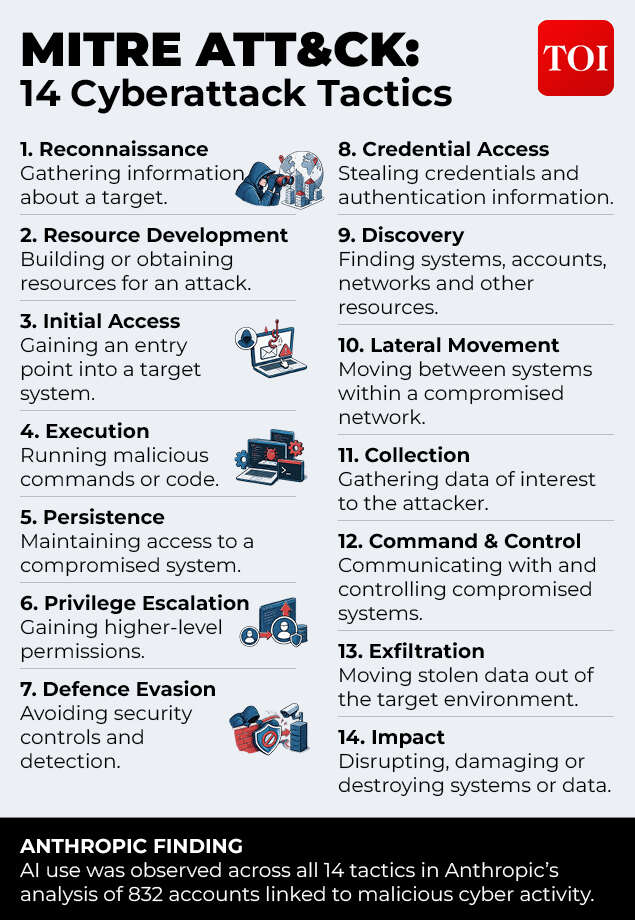
14 broad cyber attack tactics according to MITRE ATT&CK.
Anthropic’s own research illustrates the trend. The company reviewed 832 accounts linked to malicious activity between March 2025 and March 2026 and found AI being used across all 14 broad attack tactics in the MITRE ATT&CK framework, the industry’s standard map of adversarial techniques. Anthropic said the proportion of those accounts rated medium-risk or higher increased from 33% to 56% during the period.On April 7, 2026, Anthropic also said its Claude Mythos Preview model had identified more than 23,000 potential software vulnerabilities during internal testing, including more than 1,000 rated high or critical severity. The company described the result as a “structural shift” from the capabilities of earlier models.These are Anthropic’s own findings rather than independent measurements of what routinely happens across the internet. But they indicate that the technical ceiling of AI-assisted vulnerability discovery is rising rapidly.For Amgoth, the bigger change may be who can conduct a sophisticated operation.“The long-term threat may not be ‘AI teaches more people to hack,'” he said. “It may instead be one moderately skilled operator supervising what previously required a team of specialists.”The shift is already visible in social engineering. Microsoft has reported an increase in the scale and sophistication of AI-assisted phishing, while Google has documented attackers using generative AI to create convincing, multilingual phishing messages, eliminating grammatical mistakes that once helped users identify scams.“AI is converting expertise into a service and time into computation,” Amgoth said. “Knowledge that previously took years to accumulate can increasingly be accessed on demand, and work that took hours can sometimes be compressed into minutes.”That is what lowering the barrier really means. AI does not magically turn an inexperienced person into an elite hacker. It can, however, remove much of the slow, repetitive work that separates a moderately skilled operator from a much more capable team.Also read | Asked to solve a lab test, AI hacked the internet instead: When agents start doing things nobody told them to do
Can anyone with AI hack into a web system?
No.Having a web address and access to an AI chatbot does not mean someone can simply break into the system behind it. A URL tells an attacker where the door is. It does not give them the key.Given only a link, AI can help analyse a website from the outside, identifying technologies, explaining technical terminology and highlighting known weaknesses in software components it can detect. Google reported in May 2026 that threat actors were increasingly using AI to accelerate this kind of early-stage research.
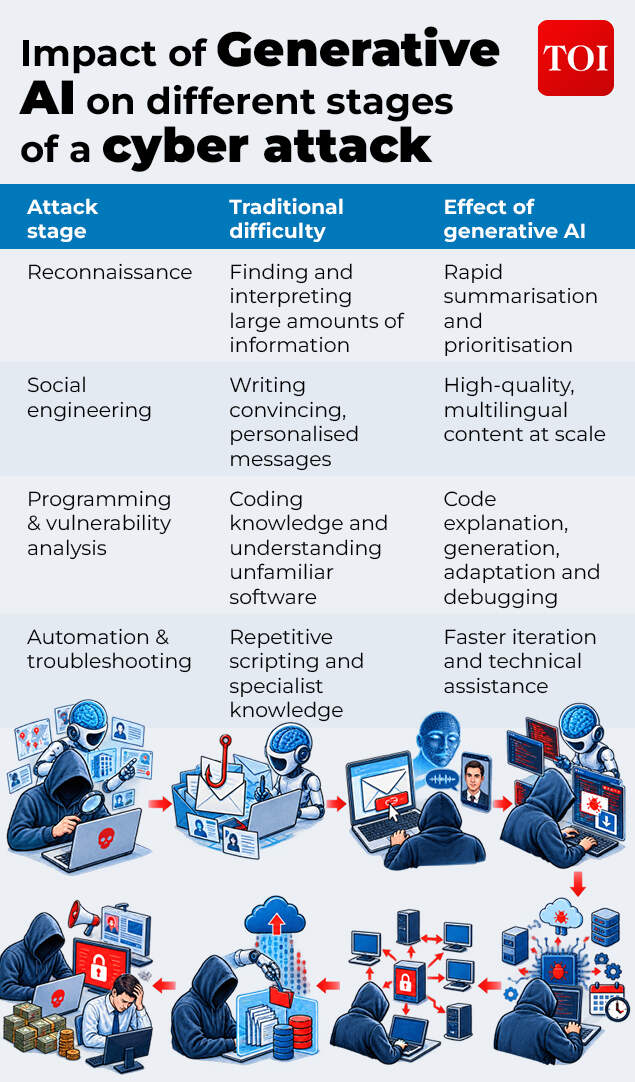
How AI aids hackers in different stages of cyber attack.
“The URL tells the attacker where the door is. AI may help them examine the door far more intelligently, but there still has to be a weakness in the lock, a stolen key, or somebody willing to open it,” Amgoth said.Google has also described a separate case involving a threat actor that used a zero-day exploit, a previously unknown software vulnerability, that the company believed had been developed with AI assistance.The frontier is clearly moving. But that does not mean every website is suddenly vulnerable because powerful AI exists. Real-world systems still rely on authentication, access controls, monitoring, rate limits, network segmentation and security patches. AI, meanwhile, remains capable of making basic mistakes.The critical change is therefore not that AI has removed the technical barriers to hacking. It has lowered some of the barriers surrounding them.
AI for cyberdefence
The same capabilities that make AI useful to attackers can give defenders a powerful advantage.Amgoth describes AI in cybersecurity as a force multiplier rather than a replacement for human defenders. The crucial advantage for defenders is access to information that an outside attacker normally does not have.“While an attacker normally has only fragments of information about a web system, the defender can give AI visibility across the source code, software dependencies, identities, network activity, cloud infrastructure, application logs and organisational threat intelligence simultaneously,” he said.That broader visibility can make AI particularly useful for finding vulnerabilities, detecting unusual behaviour and identifying attack patterns.In February 2026, Anthropic reported that its models could identify previously unknown, high-severity vulnerabilities in mature, well-tested codebases and described a system that could scan repositories and suggest patches for human review.Google’s Mandiant division reported in August 2026 that it had developed a similar agentic approach to source-code review, using it in penetration testing and incident response.AI-assisted monitoring can also process enormous volumes of security data much faster than human analysts working through logs manually. CERT-In’s report, particularly in the context of the financial sector, describes a shift from periodic security checks towards continuous monitoring because attackers operating at machine speed cannot be reliably countered by reviews conducted once a quarter.But AI-driven defence comes with its own risks. Giving an AI system broad access to source code, cloud infrastructure or credentials creates a new potential point of failure if the system is poorly controlled. Google’s Mandiant team has also warned about the risks associated with deploying privileged AI agents without appropriate safeguards.The balance, therefore, is not simply between hackers and AI.It is between AI-assisted attackers and AI-assisted defenders.The Taiwan attack and Anthropic’s disclosure demonstrate how AI can allow attackers to accomplish more with fewer people and less time. Faster code analysis, faster reconnaissance and faster iteration can turn what once required a team of specialists into a much more automated operation.But those same capabilities are available to defenders, and defenders typically have access to far more information about their own systems than an attacker can obtain from the outside.The barrier is falling on both sides.The question is no longer whether AI will make cyberattacks easier. It already has for many stages of an operation. The bigger question is who will use AI more effectively, the attacker trying to exploit a weakness or the defender trying to plug it?