A Tennessee company is breaking down retired wind turbine blades instead of sending them to landfills, recovering glass fibre at 99.9% purity that can be reused in concrete, car panels and 3D-printing filament | World News

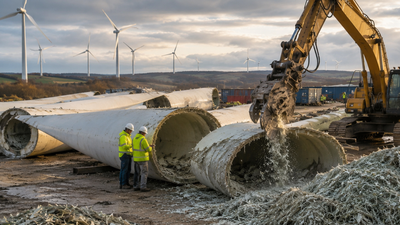
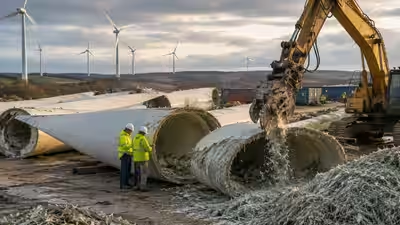
Retired wind turbine blades are becoming a growing waste challenge as older turbines reach the end of their operating lives, but a Tennessee company is developing a way to recover valuable material from them instead of sending the blades to landfill. Carbon Rivers, a Knoxville-based advanced materials company, uses a heat-based process to separate glass fibre from the polymers and resins that hold turbine blades together. The US Department of Energy has reported that the company achieved 99.9% purity in recovered glass fibre, creating the possibility of using the material again in products such as composite panels, construction materials and 3D-printing filament. The technology has received millions of dollars in federal support and research collaboration with the University of Tennessee, Knoxville. Rather than treating an old blade as waste, the process aims to turn its materials into feedstock for new manufacturing.
How a Tennessee company is recycling retired wind turbine blades
Carbon Rivers is tackling one of the hardest parts of wind turbine recycling by targeting the composite material used in the blades. The US Department of Energy estimates that around 85% to 90% of a wind turbine’s mass can already be recycled, with steel, copper and other materials having established recycling routes. The remaining fraction is much more difficult because turbine blades are made from fibre-reinforced composites, in which glass fibres are embedded in tough polymer resins. Those materials are designed to resist fatigue, weather and repeated mechanical stress, but the same durability makes them difficult to separate at the end of their service life. Carbon Rivers uses a process known as pyrolysis, which heats the composite in the absence of oxygen so that the organic resin and polymer components break down while the inorganic glass fibres remain. The recovered fibres can then be cleaned and processed for reuse. The approach is intended to preserve more of the material’s value than simply grinding blades into waste or using them in low-value applications.The recycling process works by exploiting the different behaviour of organic and inorganic materials when exposed to intense heat. During pyrolysis, the polymer components of the blade decompose without oxygen, producing hydrocarbon products including syngas and pyrolysis oil. Carbon Rivers can recover these materials for energy-related uses while separating the glass fibre reinforcement from the composite. Once separated, the fibre can be cleaned and prepared for manufacturing applications. The US Department of Energy reported that Carbon Rivers achieved 99.9% recycled glass fibre purity, a level that could allow the recovered material to be used in applications that would otherwise require virgin fibreglass. Carbon Rivers describes its technology as Glass to Glass reclamation, with the aim of taking glass-fibre composites at the end of their useful life and returning the recovered fibre to manufacturing. The process has also been investigated for other composite waste streams, including materials from the automotive and marine industries, suggesting that the technology could eventually address a broader waste problem rather than being limited to wind turbine blades.
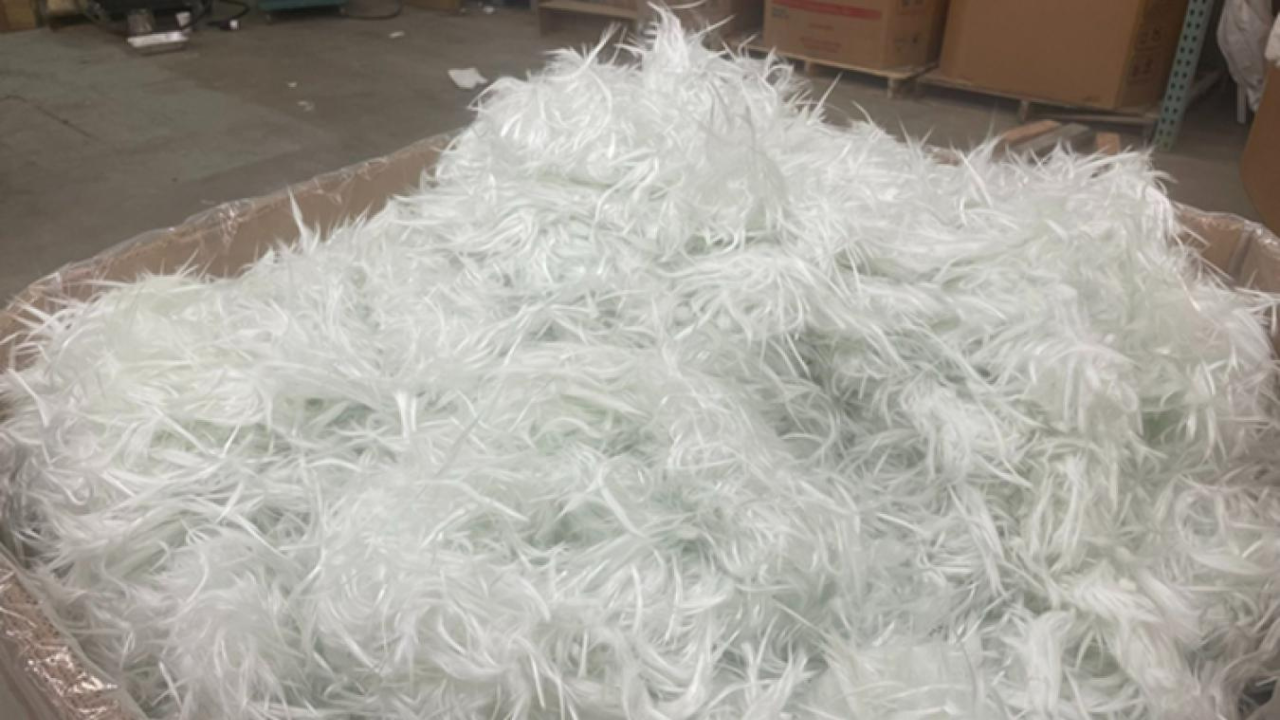
Recovered glass fibre from retired wind turbine blades, processed by Carbon Rivers.
The recovered material can be used in new products
The biggest potential advantage of recovering the glass fibre is that it can be turned into useful manufacturing material rather than simply disposed of. DOE has identified applications including non-woven mats, continuous textile yarns, thermoplastic pellets, automotive sheet-moulding compounds and filament for 3D printing. Recovered glass fibre can also be incorporated into construction materials and potentially remelted or blended with virgin fibreglass for other uses. This creates the possibility of a more circular system in which the material from an old turbine blade becomes part of another product instead of ending up in a landfill. Carbon Rivers has also worked on applications beyond wind energy, including automotive, marine and structural composite materials. That matters because glass-fibre composites are used in many industries, creating a much larger potential market for recovered material. The technology could eventually allow manufacturers to use recycled glass fibre in products such as vehicle panels, building components and other composite products while reducing their dependence on newly manufactured fibreglass.
Millions in government funding helped scale the technology
Carbon Rivers’ technology has received substantial support from the US Department of Energy. DOE reported that the company received approximately $2.4 million through its Wind Energy Technologies Office and Small Business Technology Transfer programme beginning in 2019, with researchers at the University of Tennessee, Knoxville, working with the company to scale up the recovery process. By 2022, DOE said Carbon Rivers had upcycled more than 100 tons of wind turbine blade material into products such as non-woven mats, thermoplastic pellets and 3D-printing filament. A later DOE report said the company had processed a few thousand metric tons and was working towards much greater processing capacity. In 2023, the company also received a $1.1 million Phase III award through DOE’s wind-energy technology programme to further develop the recycling process and support the use of recovered glass fibre in new composite applications. DOE has described the work as an example of technology development moving from research towards commercialisation. The government support is particularly significant because recycling old blades requires not only a technically effective process but also enough capacity to handle large and irregular waste streams generated by the wind industry.
Tennessee could help build a more circular wind industry
Carbon Rivers is based in Knoxville, Tennessee, and its recycling work has been linked to plans for a larger facility in nearby Kingston. The original DOE announcement described plans for a facility at a historic site associated with the Manhattan Project and said it was expected to process thousands of wind turbine blades each year. Those original projections should not be treated as confirmation that the facility opened on schedule, but they illustrate the scale the company was targeting as it moved from pilot work towards commercial processing. The broader need is clear. DOE says most of a wind turbine can already be recycled, but composite blades remain a major challenge, and many retired blades still go to landfill because recycling capacity and economics remain limited. Carbon Rivers is one of several companies and research groups working to change that situation. Its process does not mean every old turbine blade can now be recycled cheaply or indefinitely, but recovering high-purity glass fibre creates another route for keeping valuable material in circulation. If the technology can be scaled economically, retired blades could become a source of manufacturing feedstock for construction, automotive products, 3D printing and potentially new wind turbine components, helping reduce the amount of composite waste sent to landfill as the wind industry continues to expand.