
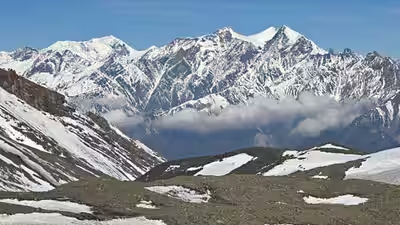
24 billion tonnes of groundwater are being lost every year across Asia’s high mountains; why the water crisis is far bigger than melting glaciers

Groundwater reserves beneath High Mountain Asia (HMA) often called the ‘Asian water tower’ are depleting at an alarming rate, according to a new satellite-based study. The region provides water that supports farming, cities, and ecosystems in more than a dozen downstream countries and is a critical resource for hundreds of millions of people. But as per researchers, groundwater storage is declining by about 24.2 billion tonnes each year in the area, said a report by Science Daily.The research was carried out by Prof. Shudong Wang of the Aerospace Information Research Institute of the Chinese Academy of Science (AIRCAS). The team sought to overcome to major obstacles to understanding groundwater in the region: limited on-the-ground data and the extremely complex mountainous landscape. The findings were recently published in Environmental Research Letters. The research was funded by the National Key R&D Program of China and the Key Program of the National Natural Science Foundation of China (NSFC).
Two decades of change
In order to develop a clearer picture of what is happening underground, the researchers created an artificial intelligence (AI) powered assessment model that combines observations from multiple satellites, Earth system modelling, and explainable AI. Using this approach, they reconstructed about 20 years of groundwater storage (GWS) changes across High Mountain Asia. The system also helped identify the main forces driving those changes and allowed the researchers to explore how groundwater risks could develop under future scenarios.For the analysis, the researchers used a framework guided by existing scientific knowledge while also drawing on large amounts of observational data. Information from multiple satellite sensors was used to estimate GWS changes over the past 20 years. To test the reliability of the results, the team compared its findings with thousands of measurements from groundwater wells as well as independent datasets. Those comparisons provided additional support for the study’s conclusions.By combining remote sensing observations, established hydrological knowledge, and interpretable AI methods, the framework helped address long-standing difficulties in studying High Mountain Asia, including rugged terrain and incomplete information about human water use.The results revealed that roughly two-thirds of HMA experienced declining groundwater storage between 2003 and 2020. The largest losses occurred in heavily populated downstream basins where irrigation demands are high, including the Ganges-Brahmaputra, Indus and Amu Darya basins. Some inland areas at higher elevations, however, experienced localised increases in groundwater storage.
Drivers of change
According to the findings, climate and human water use have driven the decline. Climate-related forces explain nearly half of the observed variation in GWS, with changes involving the cryosphere playing an especially important role. At the same time, human withdrawals of groundwater have become an increasingly significant source of depletion, particularly in downstream agricultural regions that rely heavily on irrigation. The influence of human water use became even more pronounced after 2010.Researchers also project that groundwater losses will continue if current patterns of water use remain in place. In some locations, increased glacier melt could temporarily reduce the pace of groundwater decline around the 2060s. But this “buffer effect” cannot continue indefinitely and is expected to be followed by faster losses.If the current water use patterns do not change, groundwater depletion could accelerate further, increasing the threat to agricultural areas downstream that depend on these reserves.