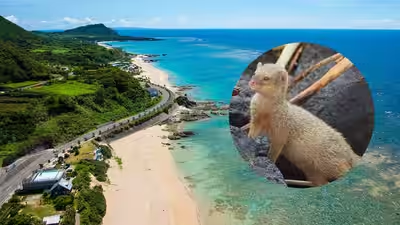
In 1979, about 30 mongooses were released on Japan’s Amami Oshima to control habu snakes; their population later grew to roughly 10,000 and threatened rare wildlife, but after decades of trapping Japan declared them eradicated in 2024

Japan has officially declared the successful eradication of the invasive small Indian mongoose on Amami Oshima, ending a decades-long ecological crisis on the UNESCO World Heritage-listed island. According to an official announcement from Japan’s ministry of the environment, expert panels confirmed that the predators have been completely removed from the 712-square-kilometre island in Kagoshima Prefecture after a long campaign of trapping, tracking and monitoring.
A biological control plan gone wrong
The problem began in 1979, when local authorities and residents released about 30 small Indian mongooses (Urva auropunctata) on Amami Oshima. The plan was to use the animals to control the venomous habu snake (Protobothrops flaviviridis), whose bites were a danger to residents and farm workers. But the plan failed because the two species have very different habits. Habu snakes are active at night, while mongooses hunt during the day. Instead of targeting the snakes, the introduced mongooses hunted easier prey, including native birds, small mammals, amphibians and reptiles. Many of these species had evolved on the isolated island for millions of years with few or no mammalian predators. With plenty of food and no natural competitors, the mongoose population grew quickly. Ministry of the Environment records show that by 2000, there were around 10,000 mongooses on the island, covering more than 80 per cent of its land area.
Severe impact on native wildlife
The growing mongoose population caused major declines in several rare species found only in the Ryukyu archipelago. Its prey included the endangered Amami rabbit (Pentalagus furnessi), a dark-furred and unusual rabbit species, as well as the Amami woodcock (Scolopax mira), Ryukyu long-furred rat (Diplothrix legata) and Ishikawa’s frog (Odorrana ishikawae). Ministry monitoring records show that sightings of Amami rabbits fell sharply near populated areas as mongoose numbers reached their peak in the late 1990s. The surviving rabbits were pushed further into remote mountain forests. The Japanese government later classified the small Indian mongoose as a Specified Invasive Alien Species under national conservation laws, requiring authorities to remove it completely.
Trapping and monitoring campaign
A major eradication programme began in 2000 under the Ministry of the Environment, with support from Kagoshima Prefecture and local governments. In 2005, officials created a dedicated team called the “Amami Mongoose Busters”. The team built a large network of controls across the island’s dense subtropical forests, using tens of thousands of live-capture traps and camera traps triggered by movement. At the height of the campaign, teams maintained as many as 30,000 traps at the same time. Rangers checked them regularly, while specially trained sniffer dogs were used to search for mongoose scent. The last confirmed mongoose was captured in April 2018. After that, environmental experts continued monitoring the island for six years. They used automatic trail cameras, environmental DNA (eDNA) testing of soil and specially trained dogs. No evidence of surviving mongooses or breeding groups was found, allowing officials to declare the eradication successful.
Native wildlife begins to recover
Removing the invasive predator has helped native wildlife recover across Amami Oshima. Biological surveys cited in Ministry control reports show that populations of Amami rabbits, Amami woodcocks and native frogs have increased. Some species have also returned to coastal lowlands and mountain valleys where they had previously disappeared. The achievement on Amami Oshima is one of the largest successful island mongoose eradication programmes in the world. It was also an important step towards the island’s recognition as a UNESCO World Natural Heritage site in 2021. Conservation authorities continue to operate biosecurity checks and monitor ports to prevent non-native species from being accidentally brought back to the island.