
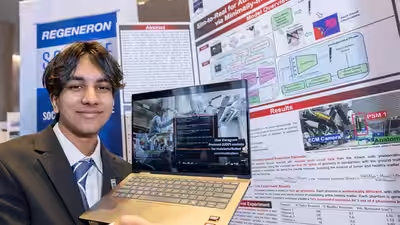
Meet Rayhan Papar, the 18-year-old Texas student who trained a da Vinci surgical robot to remove tumors; it succeeded in 3 of 4 gel-model tests

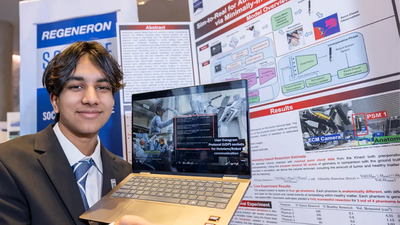
Surgical robots are already used in operating rooms around the world, helping surgeons perform complex procedures with remarkable precision. But these machines are still controlled by human surgeons. Now, an 18-year-old student from Texas has explored what it could take to teach a surgical robot to carry out one of the most delicate tasks in medicine: identifying and removing a tumour on its own.According to the Society for Science, Rayhan Papar, an 18-year-old student from Spring, Texas, developed a framework to help surgical robots learn autonomous tumour removal. His project, titled Sim-to-Real for Autonomous Tumor Resection via Minimally Invasive Robotics, was tested on a da Vinci surgical system and successfully removed whole tumours in three of four gel-model tests. Papar was also named a finalist in the Regeneron Science Talent Search 2026.
Teaching a robot to operate
The idea behind Papar’s project was not to replace surgeons or create a robot ready to perform operations on patients. Instead, his work focused on one of the biggest challenges in surgical robotics: how to train a machine to deal with the unpredictable conditions found inside the human body.A surgical robot cannot simply follow the same set of instructions every time. Every patient’s anatomy is different, and soft tissues can move, deform and change shape during a procedure. They also have to operate within a restricted visual field, while tissues can move and change size and shape during surgery. These factors make it difficult to train a robot to carry out a task independently.Papar’s solution was to begin in a simulated environment rather than directly training the robot in the physical world. He created a physics-based simulation using medical imaging to reconstruct anatomy. Within this virtual environment, the robot could learn how to approach and remove a tumour while accounting for the physical behaviour of tissues and the constraints of minimally invasive surgery.In simple terms, the robot was first given an opportunity to learn and make decisions in a computer-generated surgical setting before those lessons were transferred to a real robotic system.
From simulation to the da Vinci system
This process is often described as a “sim-to-real” approach. The aim is to use simulation as a safer and more practical training ground before testing whether the robot’s learned skills can work in the physical world. The framework was designed to bridge the gap between simulation and real-world robotic performance, allowing the system to apply its virtual learning to a physical robotic platform.The framework was then tested on a da Vinci surgical system, a robotic platform designed for minimally invasive surgery. In four gel-model tests, the system achieved complete tumour removal in three cases, according to the Society for Science.The gel models are an important detail. These were not human patients, and the results do not mean that an autonomous surgical robot is now ready for use in hospitals. Gel models provide a controlled experimental setting, allowing researchers to test a robotic system’s performance before attempting more complex and clinically relevant studies. Still, achieving complete tumour removal in three of the four tests offers an early demonstration of how simulation-based training could help robots perform highly specialised surgical tasks.
Why the research matters
Surgical robots can offer precision and dexterity, particularly in procedures performed through small incisions. However, human surgeons remain responsible for operating these systems and making critical decisions during surgery. Research such as Papar’s explores whether some parts of a surgical procedure could eventually become more autonomous. Before that could happen, however, robots would need to reliably understand changing anatomy, adapt to moving and deformable tissue, recognise surgical targets and respond safely when conditions do not match expectations.That is where the simulation component of Papar’s work becomes significant. Training in a virtual environment could potentially allow robotic systems to encounter many different surgical scenarios before being tested in physical models. The project also highlights the growing intersection of robotics, computer science, medical imaging and surgery. Rather than treating a surgical robot as a machine that simply repeats programmed movements, the research explores how it might learn to make task-related decisions within a changing environment.Papar, who attends The Woodlands College Park High School, also holds a patent for a surgical aid designed to help with brain tumour resection, according to the Society for Science. Beyond his research, he mentors other students working on STEM projects and co-founded IdeaCharge, a nonprofit that teaches children about electrical engineering.His project is still an experimental research effort, and its results should be viewed in that context. A success rate of three out of four tests in gel models is an encouraging early result, not evidence that autonomous tumour-removal robots are ready for clinical use.However, the experiment offers a glimpse into a possible future direction for surgical robotics, one in which machines may be trained extensively in realistic simulations before helping surgeons perform increasingly complex tasks. For Papar, that future began with four gel-model tests, three successful tumour removals and a question that could shape the next generation of medical robotics: can a surgical robot learn not just to follow commands, but to make the right decisions when the surgical environment changes?