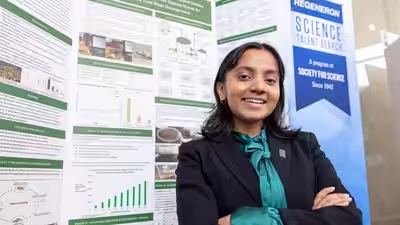
Meet Ananya Nagendra, the 18-year-old Texas student who built an ant-based digester for landfill food waste; tests found her prototype was about 83% efficient

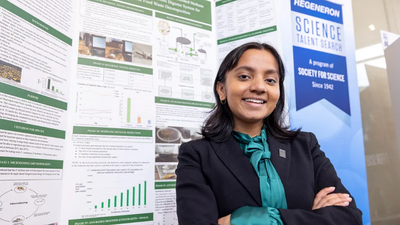
Food waste is usually thought of as a problem that begins in the kitchen and ends in a garbage bin. But once that waste reaches a landfill, it can create another environmental problem: methane. Ananya Gulur Nagendra, an 18-year-old student from Plano, Texas, wondered whether one of nature’s smallest scavengers could help tackle some of that waste. For her Regeneron Science Talent Search project, she studied how ants could break down food waste and developed a prototype of an ant-based aerobic digester. Her experiments compared four ant species to determine which could consume the most waste. She found that Camponotus castaneus performed particularly well and used those findings to design her system. Tests of the prototype found it was about 83% efficient. According to the Society for Science, which featured Nagendra as a 2026 Regeneron Science Talent Search finalist, her research could point toward a new approach to reducing the environmental impact of food waste in landfills.
The problem with food waste
Food waste does not simply disappear after it is thrown away. When large amounts of organic material are buried in landfills, it decomposes under conditions that can produce methane, a powerful greenhouse gas.According to the Society for Science, food waste produces about 58% of methane emissions from landfills. That makes finding ways to manage discarded food particularly important for efforts to reduce the environmental impact of waste. Instead of looking for an entirely artificial solution, Nagendra explored something that already exists in nature. Ants are natural scavengers and regularly collect and consume food materials. Her project examined whether their feeding behaviour could be used in a controlled system to help break down food waste.
Four ant species were tested
Nagendra began her research by testing four different species of ants. The aim was to determine how much food waste each species could break down per ant each day. The experiments showed that Camponotus castaneus consumed the greatest amount of food waste among the tested species. The species also had the highest metabolic rate, making it the strongest candidate for the system she was developing.This part of the research was important because the project was not simply based on the idea that ants eat food waste. Nagendra wanted measurable evidence showing which species could perform the task most effectively. By comparing the species, she could identify the ant that appeared most promising for a potential waste-processing system.
From experiment to prototype
After identifying C. castaneus as the most effective species in her tests, Nagendra took the project a step further. She developed a model to estimate how much methane emissions could potentially be reduced through the ants’ activity. The model connected the amount of food waste consumed with the potential environmental benefit of diverting some of that waste from conventional landfill decomposition. She then designed a prototype of an ant-based aerobic digester specifically for food waste.An aerobic digester is designed to allow decomposition to occur in the presence of oxygen. In Nagendra’s concept, ants become part of the biological process rather than relying entirely on conventional mechanical or chemical treatment methods.The proposed system was also designed with cost in mind. According to the Society for Science, Nagendra estimated that a larger version of the system could cost less than $50,000.
Prototype showed 83% efficiency
The most notable result came when Nagendra tested her prototype. The system was found to be about 83% efficient, according to the Society for Science. That result suggests the concept was capable of processing a substantial portion of the food waste under the conditions tested.It is important to note that this was a student research prototype, rather than a commercially deployed landfill system. The finding therefore represents an early-stage demonstration of the concept rather than proof that ant-based digesters are ready to replace existing waste-management infrastructure. Still, the result provides a basis for further research. Additional work could examine how the system performs with different types and quantities of food waste, how the ants behave over longer periods and how the approach might work at a much larger scale.
A finalist at a major science competition
Nagendra’s work earned her a place among the finalists of the 2026 Regeneron Science Talent Search, one of the country’s major science competitions for high school students. The 2026 finalist group included students from 35 schools across 15 states. They were selected from 300 scholars and 2,612 entrants, with more than $1.8 million in prizes available, including a top prize of $250,000. As per The Society for Science, the finalists were chosen based on the originality and creativity of their research, as well as their achievements and leadership.Nagendra’s project stands out because it connects a familiar environmental problem with an unconventional biological solution. Rather than treating ants simply as insects found around discarded food, her research asks whether their natural behaviour can become part of a controlled waste-management process.
Turning a small insect into a big idea
The idea behind Nagendra’s project is relatively simple: if ants can naturally consume and break down food, perhaps their abilities can be harnessed to process some of the waste that would otherwise end up in landfills. Her research does not solve the food-waste problem on its own, but it demonstrates how biological processes can inspire new approaches to environmental challenges.For an 18-year-old student, developing the idea from species testing to mathematical modelling and finally to a working prototype represents a substantial research journey. And with an efficiency of about 83% in her tests, Nagendra’s ant-based digester offers an intriguing starting point for researchers interested in finding more sustainable ways to deal with food waste.