Inspiring story on motherhood: “Once I had my first child, I didn’t want to leave his side”- How Chris Evert found a deeper kind of happiness after becoming a mother


For Chris Evert, becoming a mother changed what she wanted from life. The tennis great had already walked away from professional tennis when she welcomed her first son, Alexander James, in 1991. But motherhood gave her a feeling that went far beyond retirement. Evert has said, “Once I had my first child, I didn’t want to leave his side.” The simple line explains why her first child quickly became more important than the sport that had defined her for years.
Why Chris Evert did not want to leave her first child’s side
Evert became a mother on October 12, 1991, when she and her then husband, former Olympic skier Andy Mill, welcomed Alexander James Mill. She was 36 at the time and had retired from professional tennis two years earlier.Even though Evert was no longer playing full time, tennis had not completely disappeared from her life. She had worked in broadcasting after retirement and had considered taking part in team tennis and exhibition matches. Then Alexander was born, and her plans changed.In a 1992 interview with the Los Angeles Times, Evert spoke openly about the effect her baby had on her. She said she had thought about returning to the sport while she was pregnant. But after holding Alexander in the hospital, those thoughts disappeared.“I held the baby in the hospital and after the first minute, all those feelings were gone,” Evert said.That helps explain the meaning behind her later comment about not wanting to leave his side. She had spent most of her life preparing for matches, traveling for tournaments and dealing with the pressure that came with being one of the best players in the world. Now, she had a baby who depended on her, and being there with him felt more important.The change was not about suddenly disliking tennis. Evert had simply found something that meant more to her at that stage of her life.
How Alexander James changed Chris Evert’s view of motherhood
Alexander was not just Evert’s first child. His arrival gave her a new way to measure what mattered.Before becoming a mother, much of Evert’s public life centered on tennis. She won 18 Grand Slam singles titles and spent years near the top of the sport. Winning was a huge part of her identity. Motherhood gave her a role where there was no ranking, trophy or scoreboard.The Los Angeles Times reported in 1991 that Evert compared winning Wimbledon with having a baby. Her view was striking. A major title could bring happiness and recognition, but the feeling did not last in the same way. Having her child was something she could hold on to.“The great high of winning Wimbledon lasts for about a week,” Evert told People, according to the Los Angeles Times. “But having a baby, there just isn’t any comparison.”Her words show why the birth of Alexander was such a turning point. Evert had already achieved the biggest goals in tennis. She did not need another trophy to prove what she could do. Instead, she wanted to enjoy the new part of her life that had arrived.That did not mean she stopped being Chris Evert the tennis champion. It meant she had become Chris Evert the mother too, and she was learning that the second role could bring a different kind of happiness.
What Chris Evert said about raising her three sons
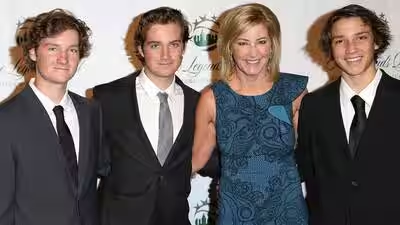
Alexander was the first of Evert and Andy Mill’s three sons. Nicholas was born in 1994, followed by Colton in 1996. Together, the boys became the center of a busy family life.Evert later made it clear that her feelings about motherhood had not faded as her children grew. In a 2001 interview with the Palm Beach Post, she spoke about Alexander, Nicholas and Colton while they were still young.“They’re my life, they’re the most important thing,” Evert said. “I’m busy, but I’m 100 percent a mom first.”That comment adds another layer to her earlier quote. Evert was not talking only about the excitement of having her first baby. She was describing a lasting change in how she saw herself.Her sons also grew up around sports because both of their parents were successful athletes. Still, Evert did not push them to follow the same path she had taken. She wanted them to enjoy being children instead of feeling that they had to become champions.In a later interview with We Are Tennis, Evert again placed motherhood above her tennis achievements. Asked about the best part of being Chris Evert, she immediately pointed to her sons and being a mother.“I love my boys,” she said. “That’s been the highlight of my life.”That answer is important because it came decades after Alexander was born. Her feelings were not limited to those first few months of motherhood. They remained part of how Evert viewed her life long after her playing career had ended.
Why Chris Evert’s words still matter years later
Evert’s quote is simple, but it says something many parents can understand. Having a child can change what feels urgent. Things that once seemed extremely important can suddenly move down the list.For Evert, that shift came after years of living with the demands of professional tennis. She had known what it meant to spend months traveling and competing. She had also known the feeling of winning major titles in front of huge crowds.Yet when Alexander arrived, she wanted to stay close to him.That decision did not erase tennis from her life. Evert later worked as a coach, mentor and commentator, and she remained connected to the sport she had helped shape. But her relationship with tennis was different because she no longer needed to prove herself through competition.Her three sons became the part of her life she spoke about with the most pride. In 2025, We Are Tennis again asked her about the best thing about being Chris Evert. Her answer centered on being a mother.That is why the line, “Once I had my first child, I didn’t want to leave his side,” carries more meaning than it may seem to at first. Evert was not simply describing a mother wanting to stay with her newborn. She was describing the moment her priorities changed.For a woman who had spent decades being defined by tennis, motherhood became the part of her identity she valued most. And for Evert, that change began with one child, Alexander, and the feeling that nothing else mattered quite as much as being beside him.