
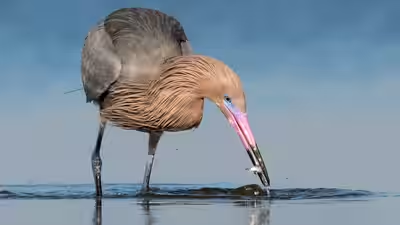
In 1923, wardens began protecting a 35-acre Texas island where the state’s last reddish egrets survived; one family lived there full time in a two-room hut, and today it holds the world’s largest nesting colony

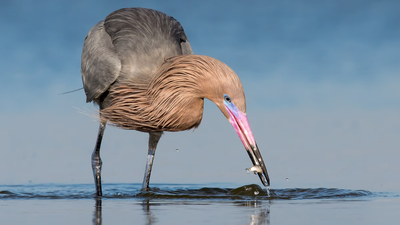
A century after wildlife wardens began protecting a small island in Texas, the 35-acre site has become the world’s largest nesting colony for Reddish Egrets. Green Island sits in the Laguna Madre, a coastal lagoon in southern Texas. In 1923, Audubon Texas signed its first sanctuary lease with the Texas General Land Office to protect the island. At the time, coastal birds were under severe pressure from hunting. Their feathers were highly valued by the fashion industry, while people also collected their eggs and hunted the birds for meat. This caused Reddish Egret numbers to fall sharply across the Gulf Coast, leaving the species close to disappearing from Texas. Today, Green Island is the centre of a much larger conservation network. Audubon Texas manages 175 coastal islands, and the Texas Gulf Coast now has the world’s largest concentration of Reddish Egrets. The islands are also home to thousands of Great Blue Herons, Great Egrets, Roseate Spoonbills and Snowy Egrets. Audubon recently highlighted the history of Green Island and the continuing work of coastal wardens in a report on a century of conservation along the Texas coast.
A difficult island became a natural refuge
Green Island is different from many of the other islands in the Laguna Madre. Most nearby islands were created from material removed during construction of the Gulf Intracoastal Waterway shipping channel. Green Island, however, formed naturally. Its location and difficult terrain made it an excellent refuge for birds. The island is far from the mainland and is covered with thick, thorny vegetation and large numbers of biting insects. These conditions made it difficult for people to reach and also kept many land-based predators away. Early conservationists recognised that the island could provide a final safe place for Reddish Egrets in Texas. During the first decades of protection, coastal wardens lived on Green Island to provide constant protection. Some lived in a basic two-room wooden hut. Alexis Baldera, coastal programme senior manager for Audubon Texas, said the warden programme played an important role in protecting nesting birds. “Green Island was one of the first pieces of land that Audubon Texas leased from the Texas General Land Office,” Baldera said. Birds had been heavily hunted for their feathers, eggs and meat, she explained. The Coastal Warden programme created a permanent human presence to protect nesting colonies along the coast.
Birds build nests at different levels
Green Island’s thick vegetation provides nesting space for many different species. The birds effectively divide the island’s bushes into different levels according to their size. Large birds such as Great Blue Herons and Great Egrets usually build their nests at the top of the vegetation, where the branches are highest. Reddish Egrets, Roseate Spoonbills and Black-crowned Night-Herons tend to nest lower down, in the thick middle section of the bushes. The smallest birds, including Snowy Egrets, use the deepest branches and lower parts of the vegetation. Other species also use the island. Glossy Ibis nest on the sandy areas, while Clapper Rails live around coastal mangrove roots. A pair of Crested Caracaras also nests there. The caracaras sometimes eat young herons, but Audubon wardens do not interfere with their nest because the birds are protected.
Protecting the island is still hard work
Green Island’s remote location offers protection, but it also makes conservation work difficult. Audubon Texas coastal warden Brian Beller has to clear and rebuild the island’s only walking trail every spring. He also removes fallen vegetation, checks for invasive predators and repairs structures damaged by storms. Although the surrounding water keeps most land predators away, some animals are able to swim to the island. Coyotes, bobcats and raccoons have occasionally crossed the lagoon. Wardens regularly check the island and remove these animals before they can reach the nesting colonies.
A special plant may help the birds
Scientists and conservation workers have also noticed an important difference between Green Island and many artificial islands in the area. Green Island has large amounts of granjeno, also known as spiny hackberry. The shrub has sharp branches and produces small orange berries. Many artificial dredge spoil islands are mainly covered with mesquite and cactus, but they have little or no granjeno. Beller believes the birds prefer nesting in the granjeno. “That plant with the orange berries that you’re talking about, that’s granjeno,” Beller said. “Almost all of the [dredge spoil] islands out here have mesquite or cactus, but they don’t have granjeno. And that seems to be the preferred plant for the birds.” Audubon is now trying to use what has been learned from Green Island to improve other islands. Beller has started collecting granjeno seeds and planting them on other islands managed by Audubon in the Laguna Madre. The aim is to create better nesting habitat and increase the number of plants that birds prefer.
Climate change creates a new threat
The biggest threat to Green Island today is no longer hunting. Instead, rising sea levels and extreme weather are putting pressure on the sanctuary. Storms have already damaged important structures. Hurricane Hanna destroyed an elevated observation blind that wardens and visiting scientists used to count birds and study nesting colonies without getting too close to the nests. The observation tower has since been rebuilt. However, the longer-term threat could be much greater. According to computer modelling cited by Audubon, rising sea levels could eventually cover as much as 15 acres of Green Island. That would mean losing almost half of the island’s current 35-acre area. Conservationists are therefore looking at ways to protect bird habitat beyond Green Island. These plans include managing vegetation on existing islands and improving artificial dredge spoil islands so they can support more nesting birds. Regular surveys will continue during every breeding season to measure nesting success and track changes in bird populations. Beller is also considering plans to restore the island’s old warden hut, built in the 1950s. The building could eventually provide a base for researchers and field biologists working on the island.
A century of protection
Green Island’s story shows how long-term conservation can change the future of a species. A century ago, Reddish Egrets in Texas were being pushed towards local extinction by hunting and egg collection. Protecting a small, isolated island gave the birds a place where they could breed without the same pressure from people and predators. Today, the island supports one of the most important Reddish Egret colonies in the world and forms part of a wider network of protected coastal habitat. The challenges have changed, however. Hunting is no longer the main danger. Rising seas, stronger storms, habitat loss and changes to coastal vegetation now threaten the sanctuary. Audubon Texas is responding by protecting existing habitat, improving other islands and studying the conditions that make Green Island so successful. The goal is to ensure that the sanctuary remains a safe place for Reddish Egrets and other coastal birds for many more years, even as the Texas coastline continues to change.