
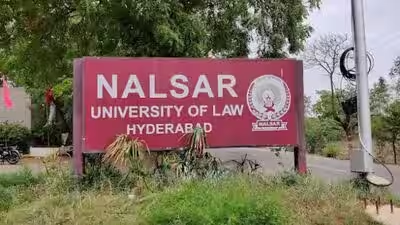

HYDERABAD: A controversy over Chief Justice of India Surya Kant being invited as chief guest for NALSAR University of Law’s upcoming convocation escalated sharply, with the Bar Council of India first ordering state bar councils to withhold enrolment of the university’s entire 2026 graduating batch, only to modify the directive within hours following widespread criticism.The issue came to a head on Friday when the Supreme Court took a stern view of the BCI’s intervention, observing that NALSAR students had a right to protest and that the matter was essentially a dialogue between the CJI and the students.A bench headed by CJI Surya Kant, along with Justices Joymalya Bagchi and V Mohana, was hearing a plea challenging the BCI’s circular. “They (students) have a right to protest. Who can stop them,” the CJI said. “It’s a dialogue between me and students. Who are they (BCI) to interfere?”The court issued notice to the BCI and directed that no punitive action be taken against NALSAR students or faculty at the instance of the BCI or any state bar council. The BCI’s counsel informed the bench that the circular had already been withdrawn. The matter has been posted for hearing after two weeks.
What triggered the controversy?
The dispute originated in opposition from a section of NALSAR students to the proposal to invite CJI Kant as chief guest for the university’s forthcoming convocation. The date of the convocation has not yet been finalised, but the CJI has traditionally been invited as chief guest.The students’ objection was linked to remarks made by CJI Kant during a hearing concerning alleged police excesses against student protesters during a march to Parliament on July 20. The petitioners had wanted the CJI-led bench to examine video footage of the alleged police action. The CJI declined, saying he did not have the time to watch the videos.Following this, a section of students wrote to the university’s vice-chancellor, registrar and professors, asking NALSAR to reconsider the invitation to the CJI.The student representation itself became the subject of the BCI’s intervention.
BCI’s first order: No enrolment for NALSAR’s 2026 batch
On August 13, the BCI directed all state bar councils not to enrol any student graduating from NALSAR in 2026 as an advocate until further orders.The council said it was examining allegations surrounding a campaign against CJI Kant’s participation in the convocation and had sought a factual report identifying those who had initiated, organised or mobilised the campaign.The BCI said a final decision would be taken on August 19 after considering the material placed before it.Its initial communication distinguished between students who had merely signed or supported representations, those who organised or coordinated the campaign, and those who allegedly proposed or mobilised an actual boycott, obstruction or disruption.It also said that participation in the representation or campaign did not, at that stage, automatically disqualify anyone from enrolment under Section 24A of the Advocates Act.However, the immediate effect of the directive was much broader: state bar councils were told to withhold enrolment of the entire 2026 graduating batch.The BCI argued that completing enrolment while the alleged conduct of particular applicants was under statutory examination could create a “fait accompli” and undermine the process.
Why did the BCI take such a strong position?
In its original communication, BCI chairperson Manan Kumar Mishra described the alleged campaign as an attempt at “intimidation of a constitutional functionary”.The letter said a law student who had no regard or respect for the highest judicial office was not expected to become a responsible advocate, teacher or judge, and suggested that such conduct could reflect adversely on a person’s suitability for entry into the legal profession.The BCI also raised allegations of groupism and internal politics at NALSAR, claiming that some academic staff had allegedly played a role in misleading or instigating students.The council said that, as the regulator of legal education, it could not remain a “mute spectator” to what it described as a serious situation.
The backlash
The decision to effectively put the professional enrolment of an entire graduating batch on hold triggered criticism from sections of the legal fraternity.Supreme Court Bar Association president Vikas Singh called the BCI’s original decision “illegal, disproportionate and fundamentally unsustainable”, arguing that it amounted to an attempt to intimidate law students for exercising their freedom of speech and expression.Singh, however, clarified that he did not support the students’ opposition to the invitation to the CJI.He said universities were meant to be spaces for free thought and fearless debate.The decision also triggered a major reaction on social media.
BCI’s first U-turn: Allow enrolment, retain inquiry
Within hours of issuing its original directive, the BCI modified it.In the revised communication, Mishra said the council had “thoroughly discussed and deliberated” on the earlier letter and unanimously decided to modify the direction concerning NALSAR students.The BCI said the “vast majority” of the university’s 2026 graduating students were innocent and had not been inclined to participate in the alleged move of disrespect.It therefore allowed all 2026 NALSAR graduates to enrol with the state bar councils of their choice.At the same time, the BCI said it would await an inquiry report from the NALSAR vice-chancellor before considering any further action.The revised communication claimed that, according to information received from “reliable sources”, a handful of teachers and outsiders may have been instrumental in allegedly instigating students.The BCI stressed that no student should be made to suffer for alleged misconduct in which they had no role.
Then came another clarification
On Friday, Mishra said the order concerning judicial internships had also been completely withdrawn following an emergency meeting of the council and that there would be no inquiry on that issue.He said the BCI’s intention was to ensure that no law student suffered any loss or obstacle in obtaining judicial internships.Mishra said the council had discussed the matter and concluded that there was no need for such an order. He added that the objective was to protect students’ academic and professional interests rather than punish them.“There will be no inquiry; there will be no inquiry whatsoever,” Mishra said, adding that the students had been wished well for their future.
Supreme Court steps in
The controversy reached the Supreme Court on Friday after a plea challenging the BCI circular was mentioned for urgent listing.The bench headed by CJI Kant questioned the BCI’s role in the dispute, stressing that students had the right to protest.The court also ordered that neither the students nor NALSAR faculty should face punitive action from the BCI or state bar councils.The BCI’s counsel told the court that the circular had been withdrawn.The court has sought the BCI’s response and listed the matter after two weeks.
CJP weighs in on the controversy
The controversy also drew criticism from leaders of the Cockroach Janata Party (CJP). CJP founder Abhijeet Dipke and party leader Saurabh Das criticised BCI chairperson Manan Kumar Mishra over the decision to initially block enrolment of NALSAR’s 2026 graduates.Das questioned why students should face punitive action for expressing dissent and accused Mishra of threatening students for voicing their views.He also raised questions about Mishra’s tenure as BCI chairman and alleged that the council had spent nearly Rs 14 crore on meetings and conferences in one year. Dipke, meanwhile, questioned whether Mishra should resign over the episode, posting on X: “Time for Manan Mishra isteefa do?”
Where the matter stands now
The immediate threat to the 2026 NALSAR graduating batch has been removed. The students can proceed with enrolment before state bar councils.The BCI has also said that, after considering representations and reactions from senior advocates, members of the Bar, law students and members of the public, it was satisfied that the 2026 batch as a whole had no role in any disturbance or movement and decided to close the proceedings altogether.Mishra said no further action was required and wished the students well, while also urging future lawyers to voice their opinions with respect and institutional decorum.The larger question — whether and to what extent a statutory legal regulator can intervene when students protest against a constitutional functionary’s participation in a university event — is now before the Supreme Court.