
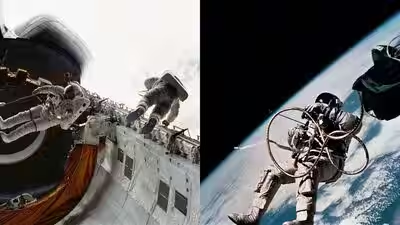

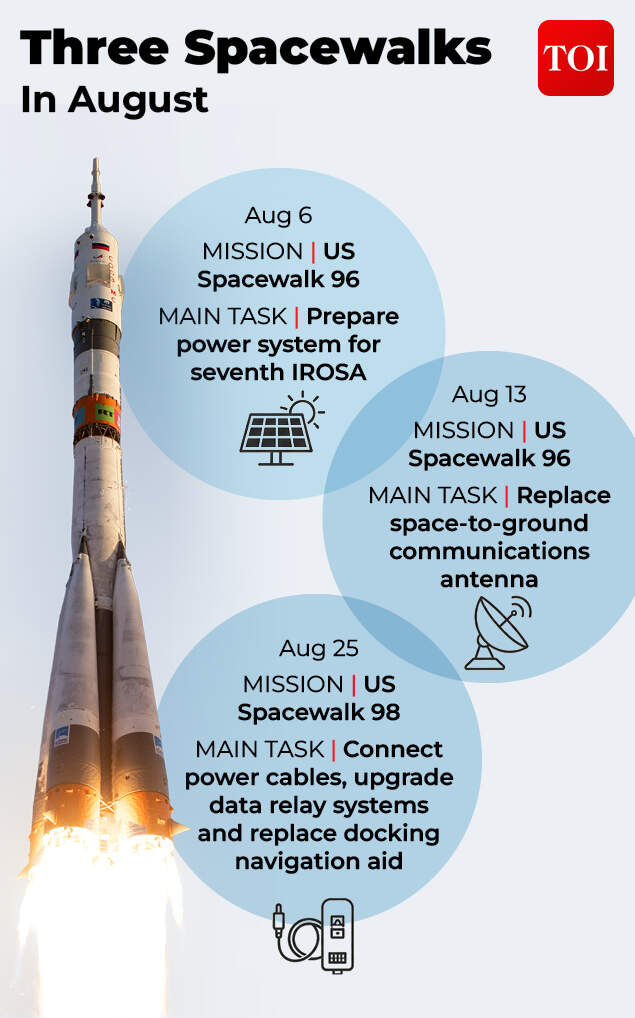
BENGALURU: Imagine opening the hatch of the International Space Station. A few minutes earlier, the airlock around you was full of air. Now it is a vacuum. Your white spacesuit is no longer just clothing. It is your spacecraft. Every breath, every heartbeat, every drop of cooling water keeping your body from overheating depends on the backpack strapped to your shoulders.A steel tether is the only thing connecting you to the station travelling around Earth at nearly 28,000 kmph. There is no up. No down. No sound. You reach for the first handrail and pull yourself outside. For the next six hours, there is no room for improvisation.This is a spacewalk, or extravehicular activity (EVA). And when Nasa astronauts Anil Menon and Jessica Meir stepped out of the Quest airlock on Aug 6 to prepare the ISS for another roll-out solar array, they were taking part in something that has taken more than six decades to perfect.
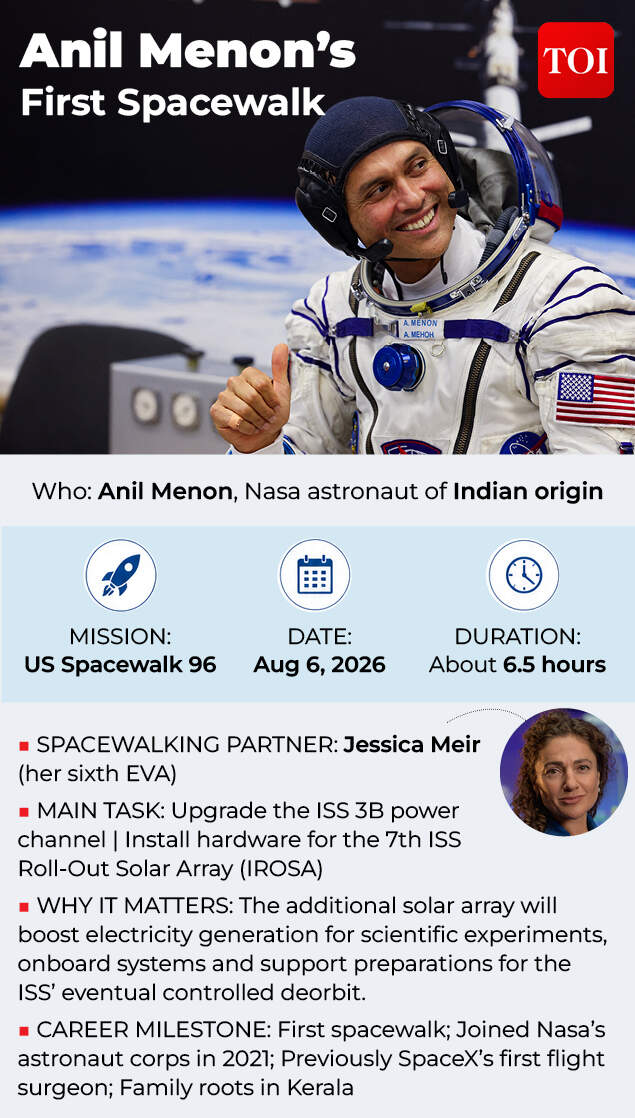
Anil Menon’s first spacewalk
From survival to skill
The remarkable thing about modern spacewalks is that they rarely look dramatic. Astronauts appear to glide effortlessly around the station, swapping cables, installing equipment and replacing antennas as though they were electricians working atop a very tall building.That illusion is the product of thousands of lessons learned, many of them painfully. The first person to discover just how unforgiving space could be was Soviet cosmonaut Alexei Leonov.
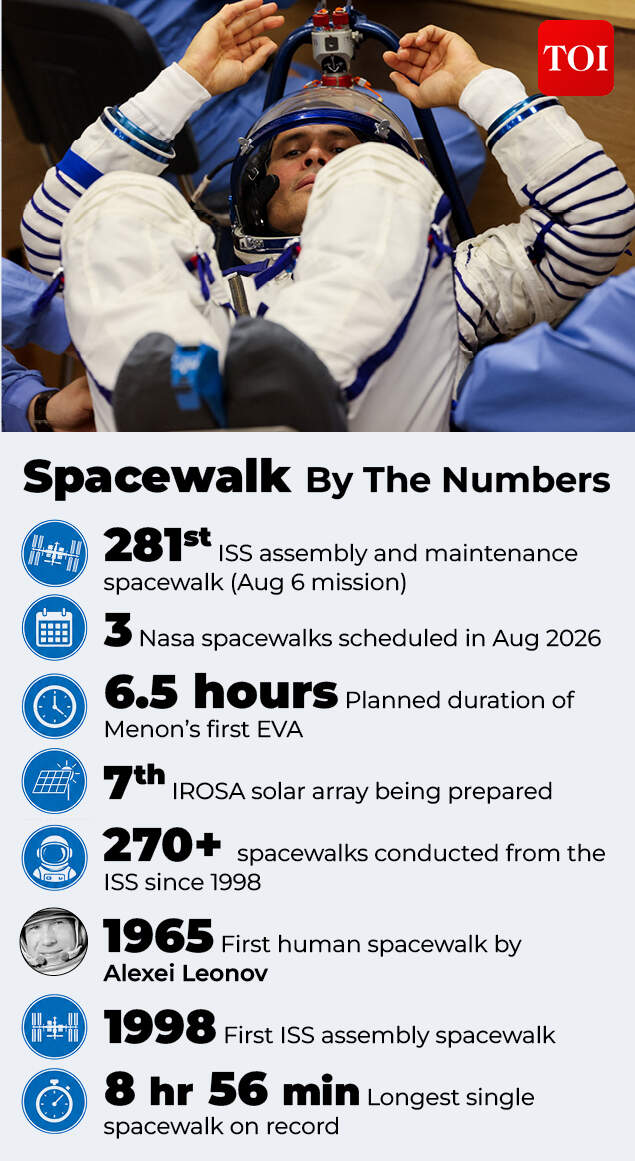
Spacewalk by the numbers
On March 18, 1965, Leonov became the first human to leave a spacecraft. His historic excursion lasted barely 10 minutes, but almost ended in disaster. The vacuum caused his suit to balloon until it became so rigid that he could hardly move. Returning through the hatch proved nearly impossible. Desperate, he deliberately lowered the suit’s pressure, accepting significant risk just to squeeze back inside.Leonov answered humanity’s first question about spacewalking: could a person survive outside a spacecraft? The answer was yes. The next question proved harder. Could they actually work? Only months later, American astronaut Ed White floated outside Gemini 4, producing some of the most iconic images of the early Space Age.But later Gemini missions revealed an uncomfortable truth. Floating gracefully was one thing; tightening bolts, connecting cables or carrying tools while wearing a pressurised suit was something else entirely. Even simple tasks became exhausting.Nasa’s answer came not in space but underwater. Astronauts spent countless hours inside giant neutral-buoyancy pools, rehearsing every movement they would later perform in orbit. The training transformed spacewalks from symbolic demonstrations into carefully choreographed engineering operations.That choreography begins long before the hatch opens. Inside the station, astronauts spend hours breathing pure oxygen. The process removes nitrogen from their bloodstream and prevents decompression sickness, much like divers ascending too quickly from deep underwater. Only then is the airlock gradually depressurised.Every tool has a designated location. Every movement is rehearsed. Every handrail has already been chosen. Mission controllers on Earth know precisely where the astronauts should be every minute of the journey.
Why space never gets easier
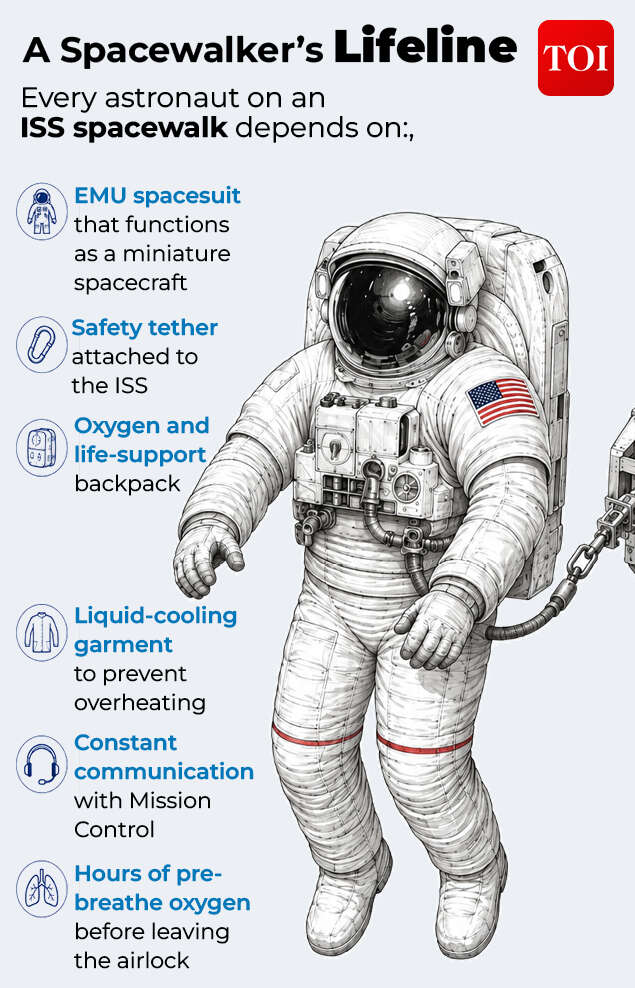
Even then, the real challenge only begins outside. A spacesuit is often described as a miniature spacecraft shaped like a human body. It must provide oxygen, remove carbon dioxide, regulate temperature, shield against radiation and tiny high-speed debris, power communications and maintain pressure in an environment where there is none.
A Spacewalker’s Lifeline
Ironically, the very pressure that keeps astronauts alive also works against them. A pressurised glove behaves less like fabric and more like an inflated balloon. Closing your fingers around a wrench requires constant force. Turning a stubborn connector can feel like exercising with resistance bands for hours. A typical ISS spacewalk lasts between five and eight hours, making fatigue a serious concern.Then there is orientation. On Earth, gravity tells us instinctively which way is up. Outside the ISS, that instinct disappears. Earth fills half your vision while the station twists above, below and around you. Astronauts rely on handrails, route maps, tethers and constant communication with Mission Control to avoid becoming disoriented.
When spacewalks became construction work
As astronauts gradually learned to survive and work in orbit, their ambitions grew. During the Apollo programme, spacewalks moved from orbit to the Moon. Astronauts no longer floated; they walked, knelt, collected rocks, deployed scientific instruments and drove lunar vehicles. Suits had to become more flexible while resisting abrasive lunar dust.The next breakthrough came unexpectedly. In 1973, Skylab suffered severe damage during launch. One solar panel failed to deploy properly, threatening the entire mission. Astronauts ventured outside to carry out repairs that engineers had never imagined would be necessary. They succeeded, demonstrating that a spacewalk was no longer just about exploration. It had become a tool for saving spacecraft.The Space Shuttle era expanded that role dramatically. Astronauts assembled the ISS piece by piece, captured satellites and repeatedly serviced the Hubble Space Telescope, replacing computers, gyroscopes, batteries and scientific instruments hundreds of kilometres above Earth. Spacewalking had evolved into orbital construction and maintenance.Even today, however, space refuses to become routine. In 2013, Italian astronaut Luca Parmitano noticed water collecting inside his helmet during a spacewalk. At first it seemed minor. Soon it covered his eyes, entered his nose and ears and made breathing increasingly difficult. Unable to see properly, he found his way back to the airlock largely through memory and touch.The culprit was not a puncture or collision but a blocked cooling system. The incident forced Nasa to redesign procedures and hardware, reminding everyone that even a seemingly healthy spacesuit can become dangerous within minutes.Years earlier, astronauts faced another unexpected crisis when one of the ISS solar arrays tore during deployment. Instead of abandoning it, engineers on the ground quickly devised a repair tool, while astronaut Scott Parazynski used the station’s robotic arm and a foot restraint to perform one of the most delicate repairs ever attempted in orbit.
The next frontier
Stories like these explain why astronauts rarely call a spacewalk a “walk”.Every successful EVA is supported by years of suit development, months of planning, hundreds of hours of underwater practice and an army of engineers following every movement from Earth.
Three Spacewalks scheduled in August
The three ISS spacewalks scheduled for August illustrate how far the technology has come. The crews are not venturing outside to prove humans can survive in space. They are upgrading power systems, replacing communications equipment and preparing the station for its remaining years before a controlled deorbit.In many ways, the history of spacewalking can be told in four chapters: First, humanity learned to survive outside a spacecraft. Then it learned to control movement. Next came the ability to perform useful work. Today, astronauts maintain an orbiting laboratory that has operated continuously for more than a quarter of a century, carrying out jobs that would have seemed unimaginable to Leonov in 1965.The next chapter is already taking shape. The Moon, and eventually Mars, will demand new suits with greater mobility, stronger protection against dust and the ability to support longer, more physically demanding missions far from immediate rescue.So the next time you watch an astronaut emerge from the ISS, remember that you are not watching someone simply floating through space.You are watching the latest page in a story written over six decades, where every handrail, every tether, every checklist and every cautious movement exists because someone, somewhere, once discovered the hard way how difficult it is to work in the vacuum beyond Earth.