
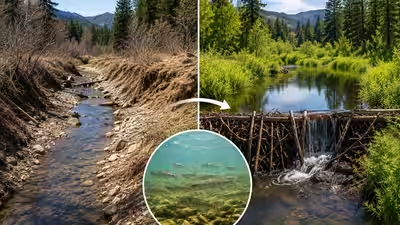
California built beaver-like dams in coho salmon creeks; at one site, mean juvenile survival rose from 8% before restoration to 60% after

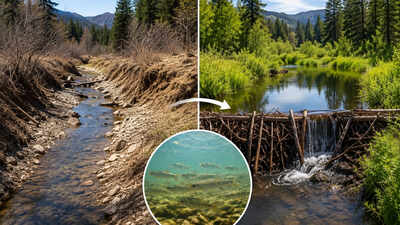
A restoration project in northern California has shown how structures designed to mimic the work of beavers can create better conditions for threatened coho salmon, particularly during drought. According to a July 2026 study published in Frontiers in Ecology and Evolution, juvenile coho salmon survival in one restored creek increased from a mean of 8% before restoration to 60% after beaver dam analogues were installed.
Recreating beaver habitat
The research focused on Sugar Creek and French Creek, two tributaries of the Scott River in California’s Klamath River watershed. The region was historically rich in beaver-created wetlands, but beaver trapping beginning in the 19th century removed thousands of animals and left the landscape largely without its former wetlands. The researchers note that the Scott River valley was once filled with beaver dams and lodges and was described historically as a large riverine wetland.With those natural wetlands largely gone, researchers and restoration groups turned to beaver dam analogues (BDAs). These are human-built structures intended to imitate some of the ecological functions of natural beaver dams without requiring beavers to construct them.The structures are relatively simple. Workers drive rows of small wooden posts into the streambed and weave branches, usually willow or conifer, between them. Gravel, mud, straw and other material can then help seal the structure, allowing it to slow water and create pond-like habitat upstream.
Two creeks, more wetland habitat
The first major BDA restoration examined in the study took place in Sugar Creek in 2015. Two structures were installed close to the creek’s confluence with the Scott River, creating approximately 0.7 hectares of slow-water habitat.In 2018, restoration expanded to French Creek after the initial work in Sugar Creek showed promising results. An off-channel pond was created, along with several smaller BDAs on a groundwater-fed side channel. The structures were monitored and maintained, including repairs when needed after high-flow events. Beavers also occupied the restoration areas at times and repaired some of the structures themselves.The restored areas substantially increased the amount of habitat available to young salmon. In Sugar Creek, the restoration created about 7,080 square metres of habitat with an estimated capacity for 6,744 juvenile coho salmon. French Creek gained another 1,858 square metres, with an estimated capacity of about 1,770 juveniles.
Survival jumped after restoration
The most striking finding came from monitoring juvenile coho salmon from brood years 2015 to 2020. Researchers tagged juvenile salmon and tracked their survival in the two creeks. In French Creek, juveniles that reared in the creek before restoration had a mean survival of just 8%. After restoration, mean survival increased to 60%. In restored Sugar Creek, mean survival was 55%. Across individual years and locations, survival ranged from 6% to 90%.The researchers also found that survival tended to be higher when conditions were cooler and wetter, as indicated by greater snowpack. Their statistical modelling identified both restoration and snowpack as positive influences on juvenile survival.The improvement is particularly important because young coho salmon spend their first summer in freshwater before migrating to the sea. In California, that means they must survive the warm and dry part of the year. Slow-moving water can provide advantages for the species because juvenile coho are well adapted to these habitats.Why slowing water mattersThe BDAs did more than simply create additional pools. They changed the physical conditions within parts of the creeks. Measurements taken at Sugar Creek showed that water in the BDA-created habitats was cooler than in unrestored areas during 2017. The restored ponds and off-channel habitat remained within more suitable temperature conditions for juvenile salmon, while unrestored sections experienced temperatures associated with greater stress.By slowing water and creating additional wetted habitat, the structures also increased water retention on the landscape, helping create cooler, more persistent habitat for salmon. That function became particularly significant during droughts.
A buffer against drought
California’s Scott River watershed is highly vulnerable to warm, dry conditions. Snowpack plays an important role in determining summer water availability, and drought can reduce the amount of suitable habitat available to cold-water fish. Parts of the tributaries can even become dry when water is scarce.The study found that restoration was associated not only with higher juvenile survival but also with increased adult coho salmon returns. The researchers found evidence that restoration muted the apparent effect of drought on returning adults, although the statistical uncertainty around the restoration-by-snowpack interaction means that this result should be interpreted cautiously.A particularly notable pattern emerged after 2017. While coho numbers declined in neighbouring, unrestored tributaries during severe drought, the Scott River system, where the restoration had taken place, maintained approximately average to above-average abundance. The timing was consistent with the return in 2017 of the first cohort of coho salmon that had reared in restored habitat in 2015.
A restoration lesson
The researchers argue that the findings highlight the importance of restoring ecological features that were historically lost. In the Scott River watershed, the disappearance of beavers, conversion of wetlands to agricultural land, groundwater withdrawals and other forms of habitat alteration left salmon with fewer cool, slow-water refuges.According to the researchers, the success of BDAs depends on site conditions, including water-table depth, channel characteristics and restoration design. Drought, water withdrawals, warming temperatures and other pressures continue to affect the watershed. However, the study provides evidence that rebuilding wetland-like habitat can improve conditions for juvenile salmon and potentially make populations more resilient during difficult water years.In this case, structures designed to imitate a natural ecosystem engineer produced a striking result: in French Creek, mean juvenile survival rose from 8% before restoration to 60% after restoration. The finding suggests that restoring lost wetland functions may be an important tool for helping threatened salmon persist in an increasingly warm and drought-prone landscape.