
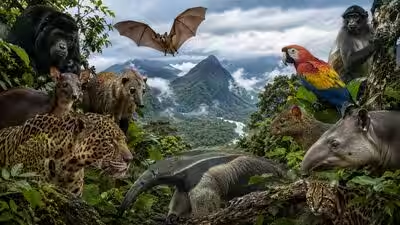
In 1998, Honduras last counted its mammals. Nearly 30 years later, 8 years of digging through 300,000 records reveal 227 native species |

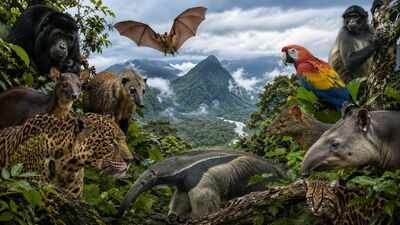
A raccoon crossing a road or a squirrel moving through a garden hardly seems like the sort of sighting that would leave a gap in a country’s scientific record. Yet in Honduras, even familiar mammals have sometimes been poorly documented on paper. For nearly 30 years, there was no single modern account showing where the country’s mammals occurred. Information existed, but it was scattered between museums, reports, field notes, scientific papers and records made by people outside formal research. Bringing those fragments together has now taken eight years of work. The resulting review documents 227 native mammal species, while also showing how much remains uncertain about animals that live in some of Honduras’s most familiar landscapes.The review does not restrict itself to Latin names and distribution records. It also records names used for mammals by Indigenous peoples and rural communities in Honduras.That reflects a wider issue in wildlife research. People living close to forests and other habitats can accumulate observations over many years, including knowledge about animals that formal surveys have not captured.
What 300,000 records reveal about the mammals living across Honduras
The new inventory did not begin with a fresh expedition into every corner of Honduras. Much of the work happened away from forests and field sites, in collections and archives where evidence of mammals had accumulated for decades.According to the study published in ZooKeys, titled, ‘Taxonomy, natural history, and conservation of the mammals of Honduras’, Manfredo A. Turcios-Casco and 14 co-authors brought together more than 300,000 individual records. The material stretched back to the 1960s and came from museum specimens, published research, technical documents and observations that had never appeared in conventional scientific journals.Every entry had to be checked against the species it was supposed to represent. That was not always straightforward. Names change as taxonomy develops, and a record that was considered correct several decades ago may no longer fit the scientific classification used today.Reportedly, Turcios-Casco, who works with the Asociación para la Sostenibilidad e Investigación Científica en Honduras and the Universidade Estadual de Santa Cruz in Brazil, described the verification stage as the hardest part of the project. The scale alone made it unusual: hundreds of thousands of records had to be assessed rather than simply counted.The resulting review identifies 227 native species belonging to 42 families and 146 genera. Three introduced rodents are also included in the wider accounting replacing a national review that dated back to 1998.
From squirrels to skunks: Several Honduran mammals remain missing from the map
The gaps were not limited to mammals that are difficult to see. Some squirrels, raccoons and small rodents had no recent distribution maps that could be used with confidence. Opossums and skunks, despite being widespread elsewhere in Central America, also remain poorly documented in parts of Honduras.That matters because a species list tells only part of the story. Knowing that an animal occurs in a country is different from knowing which forests, valleys, farms or other habitats it occupies. Distribution records provide the starting point for questions about feeding, movement, habitat use and population change.For Honduras’ endemic mammals old records may be the only evidence available. There was another problem hiding inside the archive. A handful of Honduran endemic mammals were represented by records dating back to the time they were first described, with little or no later information to show how their populations had fared.For an endemic species, that uncertainty carries particular weight. Its natural range is confined to Honduras, so information cannot simply be borrowed from populations in neighbouring countries. The inventory also reflects how much mammal taxonomy has changed over the years.
Some of the best evidence never reached a journal
Common mammals were often well represented in the material, but their evidence could be buried in what scientists sometimes call grey literature: theses, reports and other documents that are not easily found through the usual academic databases.In Honduras, that meant the researchers were dealing with a huge body of information that was effectively hidden from view until someone brought it together and tested it. It changes the picture of how much is actually known.A missing entry in a scientific paper does not necessarily mean nobody has seen the animal. It may mean the observation was written down somewhere else, stored in a collection, placed in a report or submitted by someone whose record had never been independently assessed.
The list of 227 is expected to grow
Reportedly, the study authors believe another 28 species could eventually be confirmed, potentially raising the Honduran total to 258. Marine mammals are among the strongest candidates. They are known to occur in the country’s waters, but targeted surveys have been limited, leaving the formal record incomplete.Bats are another area where the picture is patchy, particularly in eastern Honduras near the Nicaraguan border. Some rodents in the west may also be confirmed as more information becomes available, especially where their ranges extend towards Guatemala.In each case, the problem is much the same. The animals may be present, but the surveys needed to document them have not been carried out widely enough.