
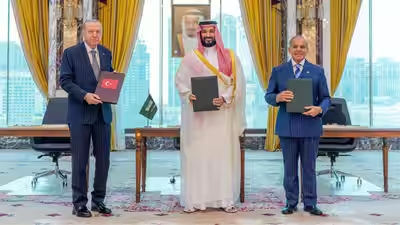

The Mecca Joint Defence Agreement, signed by Saudi Arabia, Türkiye and Pakistan on August 7, arrives at a moment of profound flux in West Asian geopolitics. Its timing and venue are intriguing. Concluded amid the lingering of the Iran conflict and rapidly shifting regional alignments, the pact declares that an armed attack against any one of the three countries will be considered an attack against all. The three governments have stressed that the arrangement is defensive and directed against no particular state.The timing and venue may appear as a Sunni counterweight to Iran. Such a reading is too simplistic and misleading. The more consequential question is why three countries that maintain close ties with the United States have chosen to formalise this arrangement now. Saudi Arabia already possesses a defence understanding with Pakistan; Türkiye is a NATO member. What additional security requirement does the trilateral format meet?Part of the answer lies in the evolving Israel-Türkiye relationship. Even before the present conflict, Israeli political and strategic discourse had begun portraying Türkiye as “the new Iran”, reflecting concerns over Ankara’s military presence in Syria, its position on Palestine and its expanding regional influence. Though contested within Israel, this signals a shift in threat perception: a weakened Iran could paradoxically elevate Türkiye as a more consequential regional competitor.
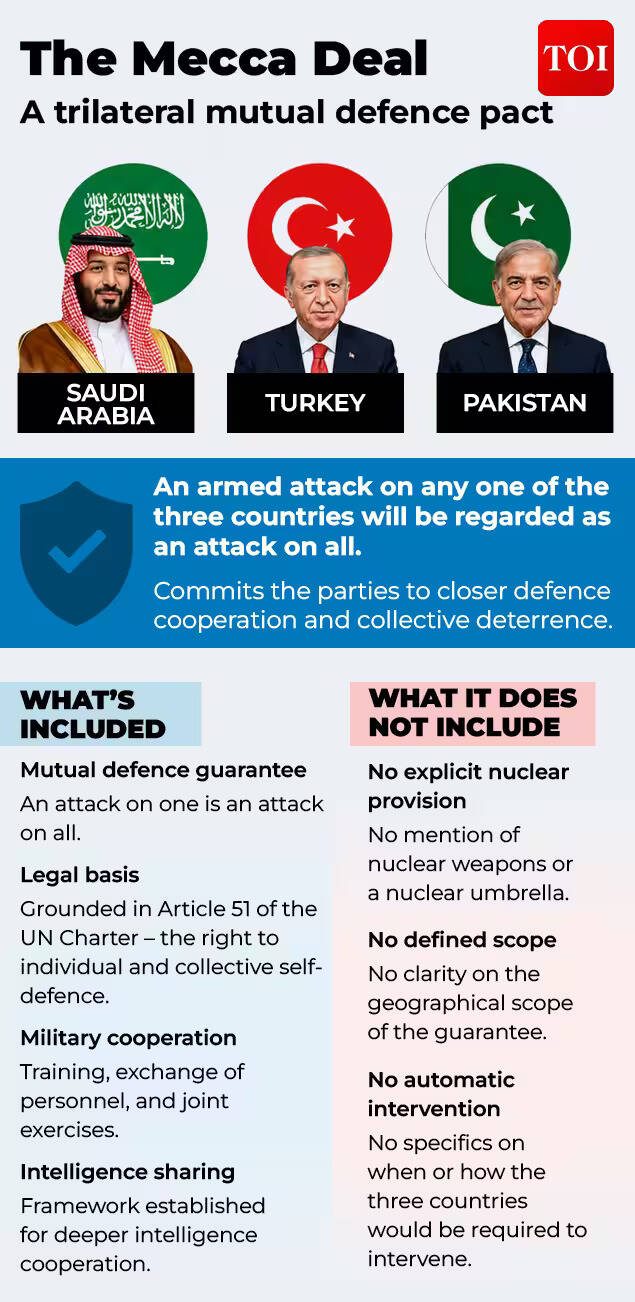
What is the Mecca Joint Defence Pact
This creates a dilemma for Washington. Israel increasingly views a stronger Türkiye as a strategic challenge, while the United States cannot afford to marginalise a pivotal NATO ally. Renewed US interest in defence cooperation with Ankara, including possible F-35 sales, has already raised Israeli concerns, adding another potential point of divergence between America and Israel after recent differences over the war in Iran. For Washington, keeping Türkiye anchored within the Western strategic framework may ultimately outweigh Israeli plans on Türkiye.Syria could become the principal theatre of this rivalry. Türkiye retains substantial influence in the north, the US remains engaged in the northeast, and Israel has strengthened its position in the south. With Saudi Arabia acquiring significant stakes in Syria’s reconstruction, competing Turkish and Israeli ambitions could make Syria an emerging theatre for future conflicts.In this environment, Washington faces constrained choices. After a costly confrontation with Iran and amid growing domestic resistance to further military entanglement in West Asia, the United States has little appetite for another conflict, particularly one involving Israel and Türkiye, a key NATO ally. Washington may therefore see value in a regional arrangement that strengthens political deterrence against further Israeli escalation and raises the costs of any confrontation between Türkiye and Israel. Viewed from this perspective, the Mecca agreement could indirectly serve American interests by containing regional escalation without requiring direct U.S. military involvement.The agreement brings together Saudi financial and diplomatic weight, Türkiye’s defence-industrial strength and military experience, and Pakistan’s nuclear deterrence. Yet these complementary capabilities do not imply complete strategic convergence. Pakistan, in particular, cannot afford confrontation with neighbouring Iran, while China remains its closest strategic partner. Such constraints, together with the divergent geopolitical and economic interests of the three signatories, make its early evolution into an operational military alliance unlikely. For now, the pact is better understood as an instrument of political deterrence, strategic reassurance and signalling.The most revealing feature of the Mecca pact may be who was left out. The absence of the United Arab Emirates is particularly significant. Although Saudi Arabia and the UAE remain important partners, their strategic interests have diverged over Yemen, Sudan, oil policy, regional leadership and, crucially, their respective approaches to Israel. Abu Dhabi’s deepening security and technological relationship with Israel since the Abraham Accords makes it a less natural participant in a Saudi-led arrangement aimed at greater strategic autonomy. The Saudi-UAE divergence and the proposed cooperation between Iran and Oman on Hormuz indicate that the Gulf can no longer be treated as a unified strategic bloc.A wider great-power calculation may also be shaping the emerging order. Washington has little interest in allowing Iran’s growing ties with Russia and China to evolve into a competing regional security axis. At the same time, it wants friendly regional powers to assume a greater share of the security burden. The Mecca agreement could indirectly serve both objectives: Saudi Arabia, Türkiye and Pakistan acquire greater strategic autonomy and responsibility for regional security while remaining broadly connected to the Western strategic system. It could thus strengthen regional deterrence without requiring either a new American military commitment or an overtly US-designed alliance.Saudi Arabia seeks greater strategic autonomy without abandoning Washington. Türkiye pursues expanded influence without exiting the Western security system. Pakistan seeks to convert military capability into geopolitical leverage while avoiding direct conflict with Iran. The United States seeks partners capable of carrying a larger share of the regional security load.For India, the emerging regional order carries a clear warning: its longstanding strategic space in West Asia can no longer be taken for granted. New alignments may not be directed against New Delhi, but, whether justified or not, perceptions of a growing tilt towards Israel or the UAE could have strategic implications. India must therefore reaffirm its balanced engagement across regional divides and communicate more effectively on India’s longstanding support for Palestine, and our principled opposition to Gulf wars in the past.Palestinian communities across the GCC and the wider region also contribute significantly to political discourse and regional perceptions. Their influence may, in some respects, be compared with the role that organised pro-Israel groups and constituencies play in American political discourse. Significantly, pro-Palestinian voices have also gained greater visibility and political traction across several Western countries in recent years. For India, therefore, its longstanding support for the Palestinian cause is not merely a legacy of the past; it remains relevant to how New Delhi is perceived across the Arab world.Historical goodwill, however, is no longer sufficient. India must translate it into contemporary strategic relevance by aligning its capabilities with the Gulf’s emerging priorities. The emerging regional arms race offers an opening for cooperation in defence technology, rare earths, critical minerals, permanent magnets and advanced manufacturing, where Gulf Sovereign Wealth funds can be roped in. Two-way partnerships in energy, refining, fertilisers and petrochemicals can further deepen economic interdependence.Equally important is correcting the imbalance in people-to-people relations. Education, scholarships, research, professional exchanges, and human-capital partnerships—adapting the principle of India’s engagement with Afghanistan—can create enduring two-way linkages.The message from Mecca is loud and clear for India: As the old West Asian order fragments and new strategic alignments take shape, historical goodwill and economic presence will no longer be enough. India must build new ‘strategic bridges across the Gulf’ on the foundations of its deep-rooted ties—or risk losing space in an emerging regional order increasingly shaped by others.Dr. B. Bala Bhaskar has over 38 years of experience as an engineer, economist, and diplomat and has handled India’s diplomatic relations with more than 70 countries.
Disclaimer: Views expressed above are the author’s own.