

Scientists uncover the aluminium shield that helps a tiny crustacean survive darkness, near-freezing water and crushing pressure in the Mariana Trench |

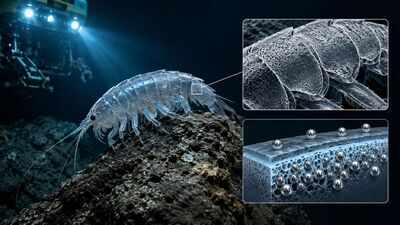
Nearly seven miles beneath the surface of the Pacific Ocean lies a place so hostile that only a handful of human beings in all of history have ever seen it. Total darkness, near-freezing water, and pressure equivalent to a jet’s weight bearing down on a single postage stamp define this world. According to Guinness World Records, the Challenger Deep, the lowest point of the Mariana Trench, reaches a verified depth of 10,935 metres, based on crewed submersible dives piloted by explorer Victor Vescovo in 2020. Remarkably, life persists even here. The amphipod Hirondellea gigas, a small shrimp-like crustacean, has made this crushing environment its home. For decades, scientists puzzled over how any creature carrying a calcium-based exoskeleton could survive such pressure without its shell simply dissolving away.
How Hirondellea gigas uses aluminium to survive crushing pressure below 8,000 metres
Crustacean exoskeletons typically rely heavily on calcium carbonate for structure and protection. According to the study published in PLOS ONE, titled ‘An aluminium shield enables the amphipod Hirondellea gigas to inhabit deep-sea environments’, this mineral becomes unstable and begins to dissolve in seawater beyond depths of roughly 4,000 to 5,000 metres, a threshold known as the carbonate compensation depth. Since Hirondellea gigas thrives at depths exceeding 8,000 metres, well past this boundary, researchers expected its shell to contain very little calcium carbonate at all.Investigating specimens captured from the Challenger Deep, researchers instead found something unexpected coating the exoskeleton: aluminium. Unlike other metals that tend to accumulate internally within an organism’s tissue, this aluminium sat directly on the surface of the shell, concentrated particularly around the tail and the edges of the legs. When researchers washed the exoskeleton with distilled water, the aluminium came away entirely, confirming it was a coating rather than a structural component absorbed into the shell itself. By contrast, a shallow-water amphipod collected from a Japanese bay for comparison showed no trace of aluminium whatsoever, suggesting this adaptation evolved specifically in response to the crushing conditions of the deep trench.
Mariana Trench pressure reaches nearly 1,000 times sea-level pressure
The hadal zone that Hirondellea gigas calls home sits at the very bottom of a broader pattern of change that defines the ocean with depth. According to NOAA Ocean Exploration, water pressure increases by one atmosphere for every 10 metres of depth, meaning that at the Mariana Trench’s deepest point, the pressure reaches roughly a thousand times what is felt at sea level. Sunlight vanishes entirely below about 200 metres, ruling out photosynthesis and leaving deep-sea animals dependent on scarce food sources drifting down from above. It is within this crushing, lightless world that Hirondellea gigas has evolved its unusual chemistry, turning to the sediment beneath it rather than the water around it for survival.The obvious question was where the amphipod’s aluminium came from and how it managed to extract it. Aluminium is abundant in ocean sediment but exists only in trace amounts in seawater itself, so researchers suspected the creature was drawing it from the mud it fed on. Metabolome analysis identified the likely culprit: a compound called gluconic acid, or its related form gluconolactone, produced within the amphipod’s body from glucose. When researchers exposed trench sediment to this compound under matching cold, high-pressure conditions, aluminium was successfully extracted, and removing the compound from the amphipod’s body fluid eliminated this ability altogether
Aluminium shield protects Hirondellea gigas exoskeleton from extreme pressure
To test whether this aluminium coating actually offered protection, researchers compared exoskeleton samples with and without the gel intact, then subjected both to pressures matching the trench floor. The results were striking. Exoskeletons stripped of their aluminium layer released significantly more calcium into the surrounding water than those left coated, indicating the gel was shielding the underlying calcium carbonate from dissolving under pressure.Additional testing extended this idea further. When researchers applied the aluminium gel to salmon roe and subjected it to the same crushing pressure, the roe showed markedly less protein leakage and no visible colour change, hinting that the coating may offer broader protection against pressure-related stress beyond simply preserving calcium carbonate.
First natural aluminium exoskeleton found in a crustacean living in the Mariana Trench
This discovery marks the first time aluminium has been documented as a natural component of any crustacean’s exoskeleton, offering a rare glimpse into how life adapts to environments once considered nearly uninhabitable. Rather than avoiding the chemistry of its harsh surroundings, Hirondellea gigas appears to have evolved a way to harness the very sediment beneath it, transforming a scarce and unlikely resource into a functional suit of armour.The Challenger Deep remains one of the least explored places on Earth, visited by fewer people than have walked on the Moon. Findings like this reinforce just how much remains undiscovered in the ocean’s most extreme corners, and how creatures far smaller and stranger than expected may hold answers to questions about survival under pressures the human body could never withstand.