

No charges for UPI users: Government clarifies person-to-person transactions to remain free; top points


Will your UPI transactions soon be chargeable? That’s the question on the minds of users since a bill cleared Lok Sabha allowing banks to charge merchants with a fee. However, the government has clarified that Unified Payments Interface or UPI transactions will continue to be free for users.In a press release, the Ministry of Finance has said that users will not be charged for making UPI payments, and all Person-to-Person (P2P) transactions will continue to remain free.It said that if a Merchant Discount Rate (MDR) is introduced in the future, it will apply only to a limited category of merchant transactions above a specified threshold and will be levied at a nominal rate, which will be significantly lower than the MDR that is applicable on debit and credit card transactions.Reports suggest that the government may permit banks and payment service providers to levy an MDR of 0.25% to 0.4% on UPI payments exceeding Rs 2,000 when the transaction is made to a business.As a result, routine payments such as those for milk, vegetables, groceries, auto-rickshaw rides and taxi fares are not expected to be affected.
Fee on UPI transactions: What the government has said
Explaining the rationale behind the amendment to the Payment and Settlement Systems Act (PSS Act), the government said recent changes have been incorrectly interpreted by some as a proposal to levy charges on ordinary users.It said the amendment is an enabling provision intended to support the long-term sustainability of UPI while strengthening its technological capabilities and resilience against emerging risks.
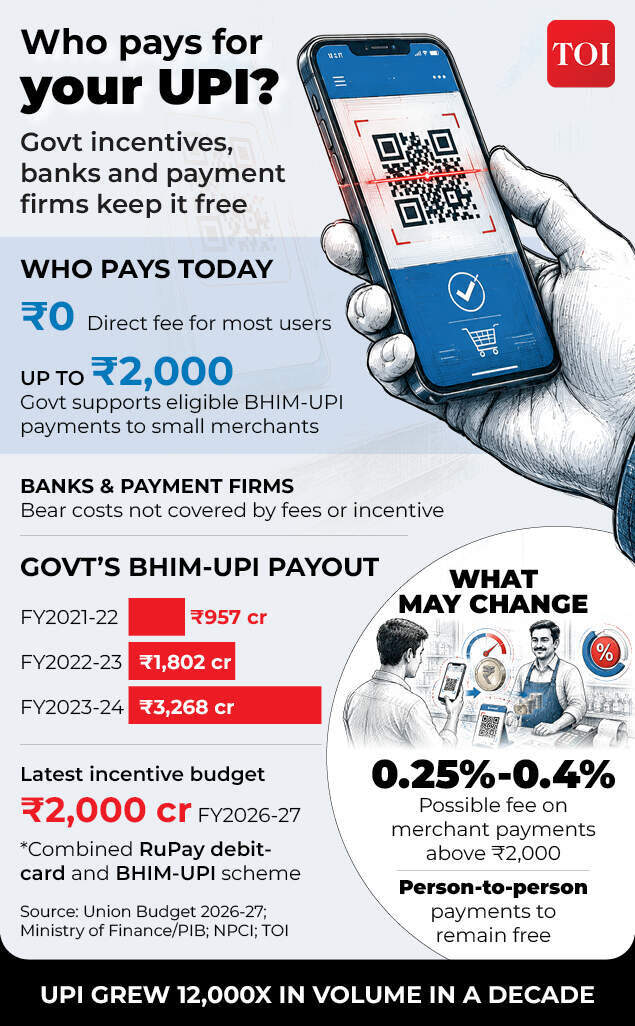
Who pays for your UPI?
The government said that the overwhelming majority of merchant transactions on UPI will continue to remain free. Any MDR, if introduced, will be threshold-based rather than imposed across all transactions.The “UPI and Services Steering Committee”, chaired by NPCI, will determine whether any MDR should be levied only after Parliament passes the Taxation and Other Laws (Amendment) Bill, 2026, which proposes changes to Section 10A of the Payment and Settlement Systems Act, 2007.
Why MDR may be introduced
According to the government, the rapid growth in UPI transaction volumes has made continuous investment in cybersecurity, fraud prevention and infrastructure essential.It also said greater competition requires more companies to expand their presence in the ecosystem, which in turn needs a sustainable revenue model.Relying solely on subsidies would not be sufficient to support the next phase of growth, making a balanced framework necessary to ensure UPI remains robust, inclusive and future-ready.It also said India is entering the next phase of digital payments growth, making it essential for the UPI ecosystem to become financially self-sustaining and affordable as it expands further into rural and semi-urban areas.Earlier this week, RBI governor Sanjay Malhotra said consumers already bear the cost of UPI transactions through the broader economy, even though merchant charges are not levied directly on them.Speaking at a press conference on the proposal to enable merchant fees on UPI transactions, Malhotra said it was too early to comment on the issue, adding that the immediate priority is to further strengthen the payments infrastructure.“It is very premature right now. Now, costs have to be paid by someone – it’s a public [good]; we all want this particular infrastructure to continue to strengthen, become more efficient. That’s our focus as of now – let’s watch how developments proceed,” he said.
External pressure to levy MDR? Government clarifies
The government also rejected reports suggesting that changes to the policy were influenced by external pressure, describing such claims as unfounded, false and misleading.The Congress on Thursday had criticised the government over the Taxation and Other Laws (Amendment) Bill, questioning whether PM Narendra Modi intends to weaken the UPI framework and allow US companies greater access to India’s digital payments sector “under pressure” from his “good friend Donald Trump”.Congress general secretary Jairam Ramesh said the latest Bill introduced by the Modi government removes the legal safeguard that ensures UPI transactions remain free of charge.The Ministry of Finance has clarified that if outside influence had played any role, India would neither have launched UPI in 2016 nor kept the platform free for both merchants and citizens since January 2020, while building it into the world’s largest real-time interoperable payment system.UPI handles billions of transactions every month. In July 2026, UPI processed 2,366 crore transactions with a total value of Rs 29.9 lakh crore, making it the world’s largest real-time payment system. The platform is now operational in 11 countries, with several more expressing interest in adopting it..